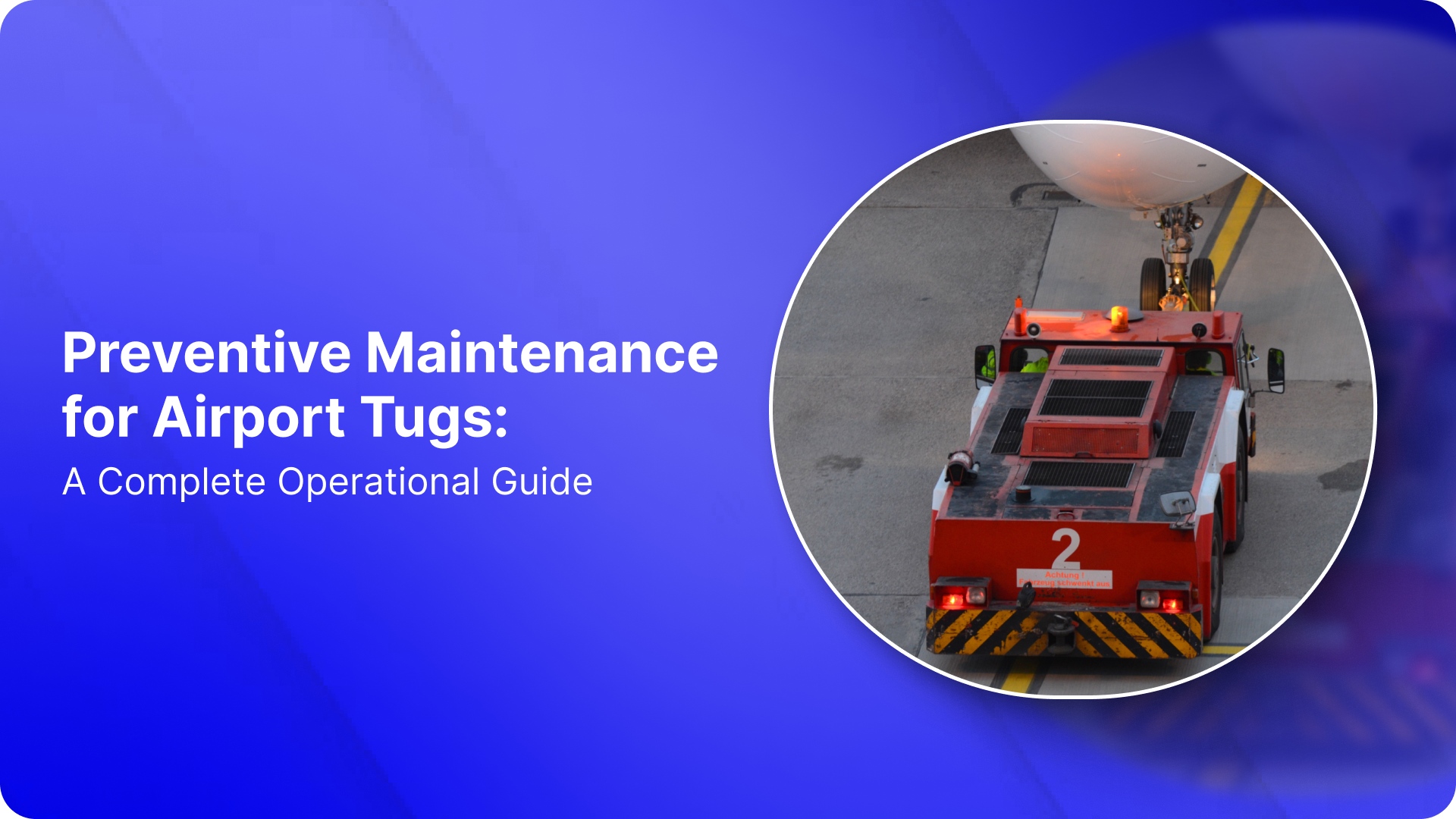
Did you know? The Federal Aviation Administration (FAA) consistently flags ramp operations as one of the highest-risk areas of airport activity. A tug issue isn’t a shop problem. It’s a live-ramp problem.
That’s why airport tug maintenance isn’t about keeping vehicles running. It’s about keeping aircraft moving.
Most tugs operate continuously, under heavy load, with little room for downtime. Preventive maintenance is the difference between controlled operations and a blocked gate when timing matters most.
This guide breaks down how airport tug maintenance decisions prevent ramp disruptions before they reach the aircraft.
Key Takeaways:
Airport tug maintenance is an operations issue: Failures affect aircraft movement, not just equipment availability.
Problems build quietly: Most tug failures develop over time and surface under load during pushback.
Preventive checks protect the ramp: Disciplined maintenance reduces safety exposure and last-minute disruptions.
Replacement readiness matters: Clear sourcing paths help teams act before tug issues reach active operations.
What Preventive Maintenance Means for Airport Tugs
Preventive maintenance for airport tugs is often misunderstood. It is not about fixing what’s already broken or keeping a vehicle in “good condition.” On the ramp, that mindset comes too late. Preventive maintenance is about ensuring a tug is ready to perform under load, in tight operating spaces, and on a fixed aircraft schedule.
For airport tugs, preventive maintenance focuses on:
Load readiness to handle aircraft weight without hesitation or instability
Safety assurance during pushback and towing in congested ramp environments
Reliability during aircraft movement, where failure is not an option
Predictable performance across repeated duty cycles
In other words, preventive maintenance protects operations at the moment that matters most, when the aircraft is already connected and movement is underway.
That focus on readiness exists because airport tugs operate under conditions that standard vehicles are never exposed to.
Airport tugs may look like vehicles, but they operate more like load-critical industrial equipment. Their working conditions leave little room for wear, delay, or degraded performance.
Key differentiators include:
Continuous stop-start duty cycles that accelerate mechanical and electrical stress
High torque and direct load transfer during aircraft pushback and towing
Tight operating areas where even small control issues increase safety exposure
Minimal tolerance for failure once an aircraft is connected and movement begins
Because of these conditions, issues that might be acceptable in standard vehicles become operational risks on the ramp. This is why airport tugs require more disciplined preventive checks, focused on readiness under load rather than general vehicle condition.
Once preventive maintenance is understood as a readiness function, the next step is identifying where airport tugs typically begin to fail.
Common Causes of Airport Tug Failures
Airport tugs don’t usually fail all at once. They fade. They keep working just well enough to stay in service, until they’re asked to do real work, under load, in the middle of a pushback. That’s when small, ignored stresses show up all at once.
Most tug failures build quietly during normal operations, long before anyone tags the unit as a problem. The key is knowing where that buildup starts.
Common failure drivers include:
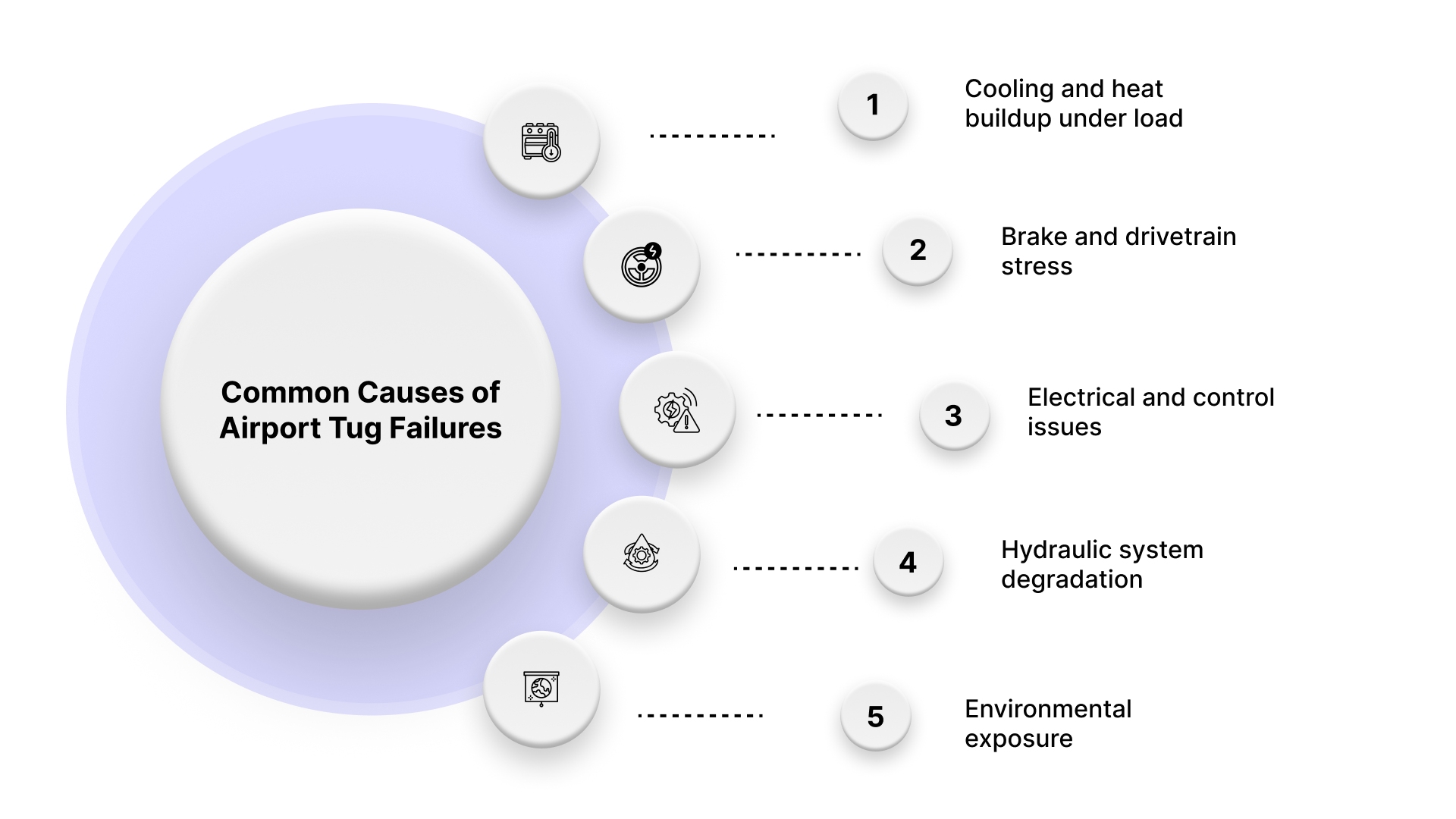
Cooling and heat buildup under load
Heat rises during repeated pushbacks, idle periods, and high-torque pulls. When cooling margins shrink, components age faster and shutdowns become unpredictable.
Brake and drivetrain stress
Stop-start duty cycles and heavy load transfer wear brakes, couplings, and drivetrain components unevenly. Early degradation often feels “normal” until control or stopping distance changes.
Electrical and control issues
Vibration, moisture, and repeated use loosen connections and degrade controls. Faults often appear intermittently before becoming hard failures at the gate.
Hydraulic system degradation
Small leaks, pressure loss, or contaminated fluid reduce response and control. These issues rarely stop a tug outright, but they erode reliability with every cycle.
Environmental exposure
Dust, moisture, fuel residue, and ramp debris work their way into systems over time. The damage is gradual, and by the time it’s visible, performance is already compromised.
Knowing how tug failures build makes it clear where preventive maintenance needs to focus before those issues reach the ramp.
Preventive Maintenance Procedures for Airport Tugs
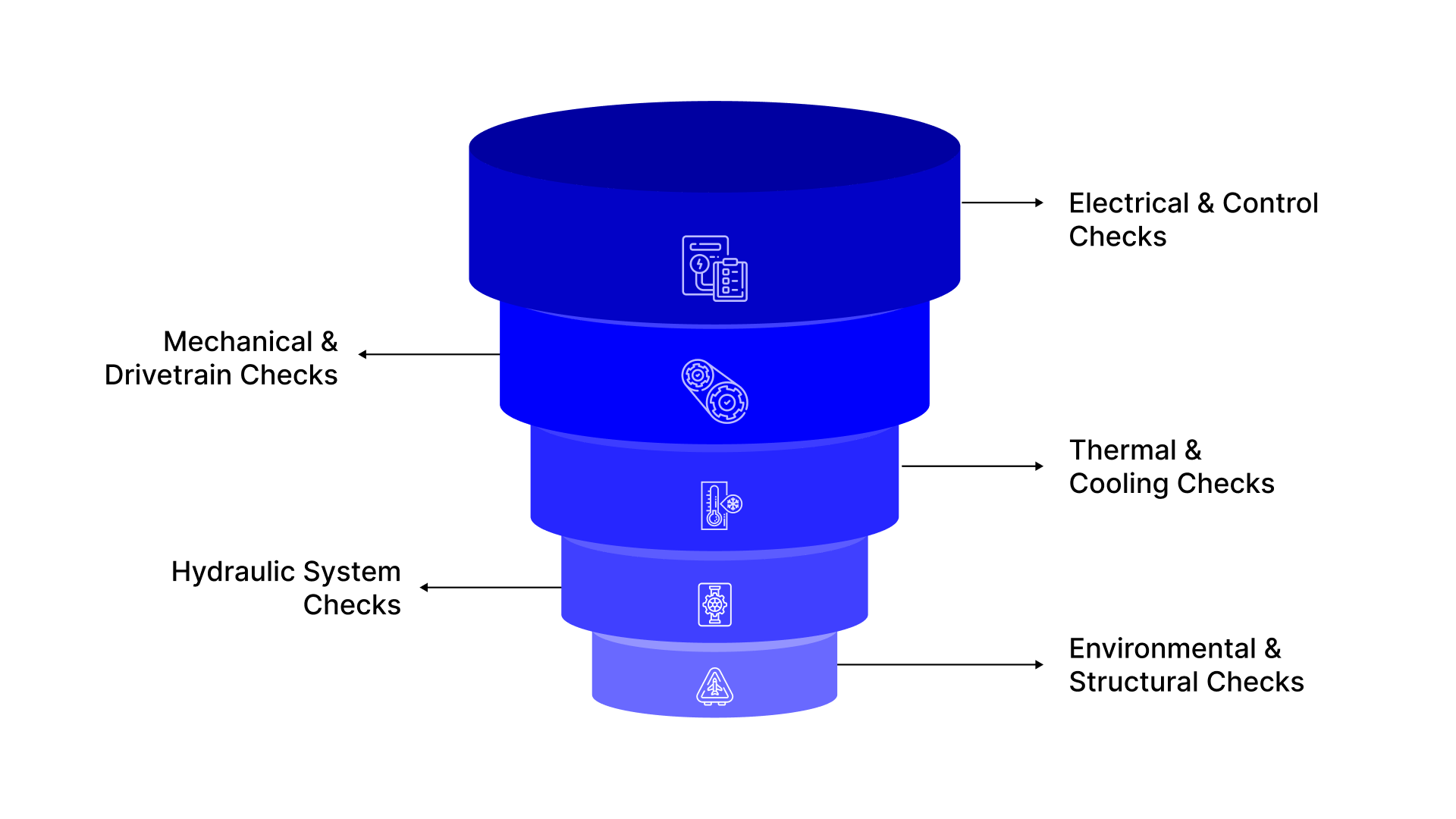
Effective preventive maintenance for airport tugs focuses on where failure begins, not where it ends. These procedures are designed around load conditions, repeated duty cycles, and ramp exposure, not static inspections.
The goal is to identify early signals that predict loss of control, degraded performance, or unsafe operation before a tug is assigned to an aircraft.
Below are the key preventive maintenance areas, organized by risk, with checklists built for fast, repeatable inspections.
Electrical & Control Checks
Controls are the first place where instability shows up, especially under load or during repeated starts.
Checklist
Verify smooth, predictable control responsiveness
Inspect wiring for wear, looseness, or abrasion
Check warning indicators for proper function and clarity
Confirm no intermittent faults during operation
Mechanical & Drivetrain Checks
Drivetrain components absorb the stress of pushback and towing. Small changes here can quickly become safety issues.
Checklist
Inspect brakes for wear, response, and consistency
Check axles and couplings for play or uneven wear
Verify steering components move freely without delay
Listen for abnormal noise during movement or load transfer
Thermal & Cooling Checks
Heat buildup accelerates wear across multiple systems and often goes unnoticed until reliability drops.
Checklist
Confirm unobstructed cooling airflow
Look for signs of heat buildup after operation
Inspect supporting cooling components for blockage or damage
Check for debris restricting ventilation paths
Hydraulic System Checks
Hydraulics affect control, braking, and stability. Degradation here reduces predictability.
Checklist
Inspect hoses for cracking, abrasion, or stiffness
Check for leaks at fittings and connection points
Verify pressure remains stable during operation
Watch for delayed or inconsistent response
Environmental & Structural Checks
Ramp conditions accelerate wear in ways controlled environments do not.
Checklist
Check for corrosion on exposed components
Inspect frame integrity for cracks or deformation
Look for damage from ramp traffic or ground equipment
Confirm protective covers and seals remain intact
Even with these checks in place, the real difference shows up in whether issues are caught early, or allowed to surface during active ramp operations.
Preventive Maintenance vs Ramp-Level Tug Failures
The real cost of tug failures isn’t the repair itself, it’s where and when the failure occurs. Preventive maintenance failures show up quietly in the shop or during inspections. Ramp-level failures show up with an aircraft already attached, crews waiting, and zero room to pause operations. That difference changes every decision that follows.
For operations and maintenance leaders, the contrast looks like this:
Aspect | Preventive Maintenance Model | Ramp-Level Tug Failure |
Aircraft movement impact | Tug removed from service before assignment | Aircraft movement halted mid-operation |
Safety exposure | Controlled environment with standard procedures | Elevated risk in congested ramp conditions |
Crew behavior | Planned tasks executed by assigned teams | Improvised workarounds under time pressure |
Escalation pressure | Normal reporting and approval paths | Rapid escalation across ops, safety, and management |
Operational visibility | Issues tracked and addressed early | Failures become immediately visible events |
Recovery options | Multiple controlled paths available | Limited options dictated by gate and aircraft status |
Use this comparison to evaluate where most tug issues are currently being addressed. If failures are frequently discovered during active pushback or towing, maintenance is happening too late in the cycle.
A preventive model shifts problems upstream, where teams have time, options, and control before aircraft movement is affected.
When preventive maintenance identifies a component that needs replacement, the next challenge is securing that part without disrupting ramp operations.
How Manufacturing-Only Support Fits into Tug Maintenance Readiness
In airport tug maintenance, not every issue requires service intervention. Often, preventive checks do their job, they identify a component that has reached the end of its reliable life and needs to be replaced.
At that point, readiness depends less on troubleshooting and more on how quickly and cleanly that replacement can happen.
This is where manufacturing-only support fits into tug maintenance readiness.
Manufacturing-only suppliers operate differently from service providers or OEM service arms. Their role is focused on building and supplying replacement components, not maintaining or repairing equipment in the field. For airport teams, this distinction matters because it keeps responsibilities clear while reducing delays when replacements are required.
In practical terms, manufacturing-only support helps by:
Providing replacement components when preventive maintenance flags wear or degradation
Supporting like-for-like builds that allow existing tugs to return to service without redesign or modification
Reducing reliance on time-sensitive service availability when a component simply needs to be replaced
Giving procurement teams a defined sourcing path for critical parts identified during inspections
For example, manufacturers like FSR Products build radiators used in airport ground support equipment, supplying replacement components when heat-related wear or cooling issues are identified.
By separating maintenance responsibility from manufacturing support, airports maintain control over tug reliability while improving readiness to act before issues escalate to the ramp.
Conclusion
Airport tug maintenance isn’t about keeping equipment running for its own sake. It’s about making sure aircraft keep moving when the ramp is already under pressure. Most failures don’t come out of nowhere, they show up when readiness gaps haven’t been addressed early enough.
As fleets age and service support becomes less predictable, separating maintenance work from component availability matters more than ever. Manufacturing-only support fits here. By building radiators used in airport ground support equipment, FSR Products helps airport teams stay prepared when replacements are needed, without adding service complexity.
If you’re rethinking your approach to airport tug maintenance, replacement planning, or supplier dependency, it’s worth having that conversation early.
Reach out through the Contact Us page to connect with FSR.
FAQs
1. Why do tug issues often appear only during pushback, not during inspections?
Many tug problems stay hidden until the unit is under full load. Pushback combines torque, braking, steering, and control inputs all at once, exposing weaknesses that routine checks may not trigger.
2. How does airport tug maintenance impact ramp safety, not just schedules?
A tug failure during aircraft movement increases collision risk, crew exposure, and decision pressure. Maintenance readiness directly affects how safely issues are handled on the ramp.
3. What maintenance gaps most often lead to last-minute tug removals from service?
Cooling issues, brake wear, hydraulic degradation, and control instability are common culprits. These tend to build gradually and are often underestimated until reliability drops.
4. How should airports manage tug maintenance across mixed or aging fleets?
Mixed fleets require clearer inspection priorities and replacement planning, since support levels and part availability can vary widely between tug models and vintages.
5. When should an airport revisit its airport tug maintenance strategy?
If tug issues are frequently discovered during active operations—or replacements are sourced under time pressure—it’s a sign the maintenance approach needs to shift earlier in the cycle.