Radiator failures almost never happen all at once. What usually takes a system down is one stressed, overlooked part that finally gives way. A blocked flow path. A weakened connection. A component that’s been absorbing heat and vibration longer than the rest.
That’s why understanding radiator components is a practical advantage, not a technical exercise. When teams know how individual components behave under real operating conditions, they can diagnose issues faster, plan replacements with more confidence, and avoid repeat failures that keep coming back after “fixes.”
This guide breaks down radiator components in the context that matters most: failure risk, replacement planning, and long-term reliability.
Key Takeaways:
Radiator failures start at the component level: Heat, vibration, and flow stress don’t affect all parts equally.
Component insight prevents repeat issues: Knowing which radiator components fail first supports better diagnosis and planning.
Targeted replacement reduces downtime: Not every issue requires a full radiator replacement.
Manufacturing-only support matters: Component availability enables faster, cleaner replacement when servicing isn’t required.
What “Radiator Components” Really Means in Industrial Systems
In industrial systems, radiator performance is rarely limited by the radiator as a whole. It’s limited by how individual components respond to real operating stress over time. Two radiators can look identical on paper and behave very differently once they’re installed, simply because their components are being pushed in different ways.
To reset expectations:
Not all radiators behave the same in operation
Similar-looking radiators can age differently because internal components experience uneven heat concentration, vibration, and flow stress depending on system layout.
Application defines which components work the hardest
Equipment that runs intermittently stresses components differently than equipment that runs continuously or under peak load. The weakest component is usually the one absorbing the most variation, not the most heat.
Duty cycle determines how failures build
Repeated start-stop cycles, long run times, or extended idle periods each accelerate wear in different component zones. Some parts degrade quietly until performance suddenly drops.
Operating environment reshapes failure patterns
Dust, moisture, debris, and airborne contaminants don’t affect every component equally. They concentrate damage in specific connection points, airflow paths, and structural interfaces.
Failure risk is concentrated, not evenly distributed
A small number of components carry a disproportionate share of stress. Understanding which ones those are is what separates repeat failures from lasting fixes.
With that context in place, the next step is to look at the core radiator components based on what they actually do, not just what they’re called.
Core Radiator Components (Explained by Function)
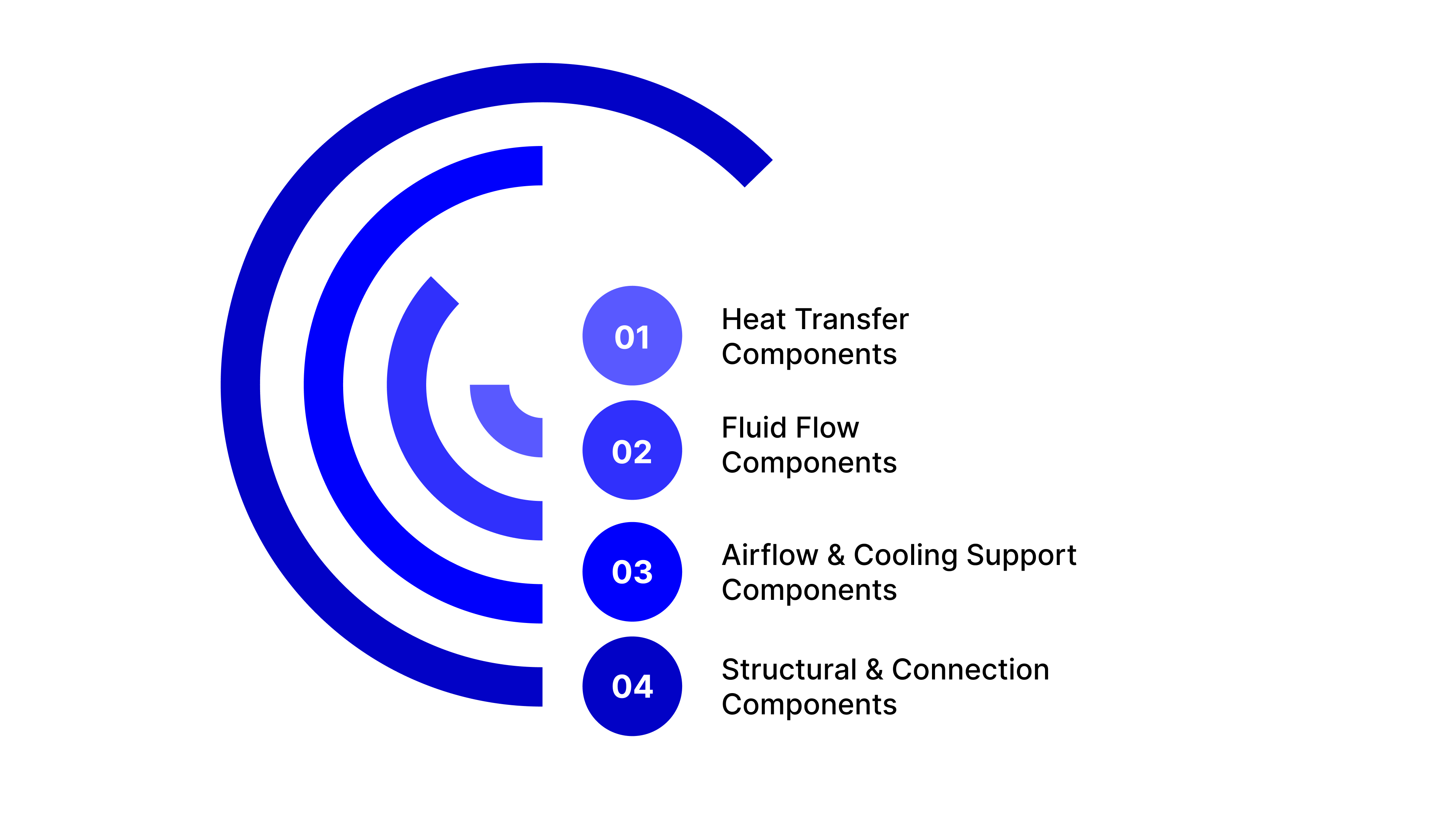
When a radiator underperforms, the issue is rarely abstract. It’s tied to how specific components handle heat transfer, fluid movement, and airflow under real operating conditions.
Understanding radiator components by function, rather than by name alone, makes it easier to pinpoint where reliability starts to break down.
These components do the primary work of moving heat out of the system. When radiator performance drops, issues here are often the root cause, even if the failure shows up elsewhere.
Heat Transfer Components
Heat transfer components do the heaviest lifting in a radiator. They absorb sustained thermal load, operate continuously under stress, and determine how efficiently heat is moved out of the system.
Because these components are always working, they are often the first to show early signs of performance loss when conditions change or margins tighten.
1. Core
The core is the working center of the radiator. It’s where heat exchange actually happens and where most long-term stress accumulates.
What it does: The core transfers heat from the circulating fluid to the surrounding airflow. Its efficiency directly determines how well the system can maintain operating temperatures under load.
How heat stress affects it: Heat stress builds gradually and concentrates in areas with uneven flow or restricted airflow.
Localized hot spots develop over time
Repeated thermal cycling weakens internal pathways
Small inefficiencies compound under continuous operation
Common early degradation signs: Early issues are often subtle and easy to overlook.
Reduced cooling effectiveness under load
Inconsistent temperature behavior
Performance drops that recover temporarily after shutdown
2. Tubes
Tubes carry fluid through the radiator core. They experience constant internal pressure, heat, and flow variation.
What they do: Tubes move heated fluid through the core, allowing heat to be transferred outward. Flow consistency here is critical for stable cooling performance.
How heat stress affects them: Thermal expansion and contraction place repeated stress on tube walls and joints.
Expansion fatigue builds at stress points
Flow restrictions develop as internal surfaces degrade
Small weaknesses grow under sustained heat
Common early degradation signs: Tube-related issues often appear as gradual performance loss.
Minor flow imbalance
Early-stage seepage or pressure inconsistency
Cooling performance that worsens over time, not suddenly
3. Fins
Fins are responsible for maximizing heat dissipation by increasing surface area exposed to airflow.
What they do: Fins transfer heat from the core and tubes into the air. Their effectiveness depends on airflow access and physical integrity.
How heat stress affects them: Heat weakens fin structure, especially when airflow is uneven or obstructed.
Reduced heat transfer efficiency
Increased sensitivity to airflow blockage
Accelerated wear in high-heat zones
Common early degradation signs: Fin degradation often shows up before major failures.
Localized overheating despite normal fluid flow
Reduced cooling response during peak operation
Gradual loss of overall thermal efficiency
Fluid Flow Components
Fluid flow components control how heat actually moves through the radiator. Even small disruptions here can reduce cooling effectiveness long before a visible failure appears. Most problems develop gradually, driven by restriction, internal stress, and slow leak formation.
1. Headers
Headers distribute fluid into and out of the radiator core. They manage flow balance and absorb pressure changes during operation.
What they do: Headers route heated fluid evenly across the core, helping maintain consistent cooling performance under load.
How flow stress affects them: Stress concentrates where flow changes direction or pressure fluctuates.
Uneven distribution increases localized heat buildup
Repeated pressure cycles fatigue internal joints
Flow imbalance amplifies stress on adjacent components
Common early degradation signs
Subtle flow inconsistency across the core
Minor seepage at joints or seams
Performance drops that worsen under sustained load
2. Tanks
Tanks act as collection and transition points for fluid entering and leaving the radiator.
What they do: They stabilize flow and pressure as fluid moves through the system, supporting consistent circulation.
How flow stress affects them Internal pressure and thermal expansion work together over time.
Wall stress increases with repeated heat cycles
Expansion and contraction weaken seals
Internal stress accelerates material fatigue
Common early degradation signs
Slow-developing leaks rather than sudden failure
Pressure instability during operation
Reduced cooling efficiency under peak demand
3. Inlet and Outlet Paths
Inlet and outlet paths are high-stress zones where fluid velocity and direction change abruptly.
What they do: They guide fluid into and out of the radiator, setting the conditions for flow through the entire system.
How flow stress affects them: These paths experience concentrated stress from velocity, temperature, and pressure shifts.
Flow restriction builds at bends and transitions
Thermal cycling weakens connection points
Stress accumulates where vibration is present
Common early degradation signs
Gradual restriction that reduces overall flow
Intermittent seepage at connection points
Performance that degrades unevenly rather than uniformly
Airflow & Cooling Support Components
Airflow and cooling support components don’t move heat themselves, but they determine whether heat can leave the radiator at all. When these parts underperform, the radiator often gets blamed, even though the core and fluid paths may still be intact.
1. Shrouds
Shrouds control how air moves across the radiator surface, ensuring airflow is directed where it’s needed most.
Why airflow failures mimic radiator failure: When shrouds are damaged or misaligned, airflow bypasses the core instead of passing through it.
Heat transfer efficiency drops without obvious fluid issues
Cooling performance degrades evenly, not suddenly
The radiator appears “weak” despite no internal damage
Why they’re often overlooked: Shrouds don’t usually trigger alarms or leaks.
Degradation is visual and gradual
Minor misalignment is easy to dismiss
Issues rarely stop operation immediately
2. Fans (if applicable)
Fans provide forced airflow when natural air movement isn’t sufficient, especially at low speeds or idle conditions.
Why airflow failures mimic radiator failure: Reduced fan performance limits heat removal even when fluid flow is normal.
Overheating appears under low-speed or stationary operation
Temperature recovers once airflow improves, masking the cause
Why they’re often overlooked: Fan issues are intermittent and load-dependent.
Partial performance loss is hard to detect
Noise or vibration changes are often subtle
Problems may only appear under specific operating conditions
3. Mounting Interfaces
Mounting interfaces hold the radiator and airflow components in position, maintaining alignment and vibration control.
Why airflow failures mimic radiator failure: Poor mounting affects airflow consistency and structural stability.
Misalignment reduces effective air passage
Vibration accelerates wear across multiple components
Why they’re often overlooked: Mounts are rarely inspected unless something is visibly loose.
Degradation happens gradually
Issues are often attributed to “normal vibration”
Structural & Connection Components
Structural and connection components hold the radiator together as a working assembly. They don’t transfer heat or move fluid, but they absorb vibration, maintain alignment, and protect against environmental exposure. When these parts degrade, they often trigger secondary failures elsewhere in the system.
1. Mounting Brackets
Mounting brackets secure the radiator in position and manage vibration from the surrounding equipment.
Vibration and alignment risk
Continuous vibration loosens fasteners over time
Minor misalignment increases stress on adjacent components
Movement under load accelerates wear across the assembly
Environmental exposure impact
Corrosion weakens structural integrity
Debris buildup affects bracket performance
Exposure shortens service life in harsh conditions
2. Seals
Seals protect internal components by preventing fluid leaks and blocking contaminants.
Vibration and alignment risk
Repeated movement degrades sealing surfaces
Misalignment causes uneven seal compression
Small gaps grow under thermal cycling
Environmental exposure impact
Heat and moisture accelerate seal breakdown
Contaminants compromise sealing effectiveness
Early degradation often goes unnoticed
3. Connection Points
Connection points link the radiator to the rest of the system, making them high-stress interfaces.
Vibration and alignment risk
Movement concentrates stress at joints
Loose connections increase internal pressure strain
Repeated micro-movement weakens interfaces
Environmental exposure impact
Moisture and debris accelerate corrosion
Exposure increases the likelihood of seepage
Failures develop gradually, not suddenly
When performance starts to slip, it’s rarely random; certain radiator components consistently reach their limits before the rest of the system does.
Which Radiator Components Fail First (And Why)
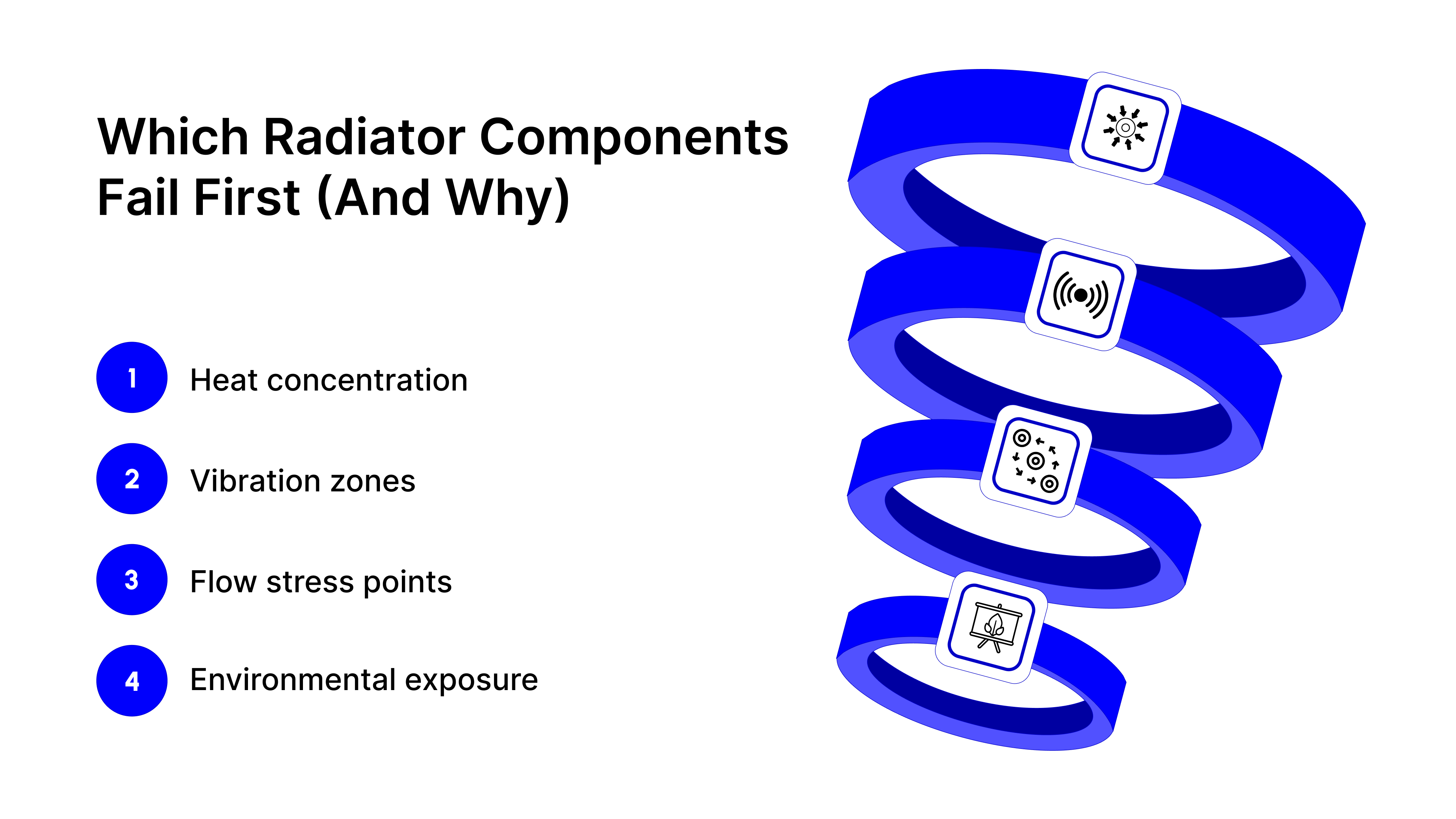
Radiator failures rarely come down to chance. In most systems, the same components tend to fail first, not because they are poorly designed, but because they absorb disproportionate operating stress. These early failures follow clear patterns tied to how heat, movement, and environment interact inside the system.
Understanding why certain radiator components fail first helps teams move from reactive fixes to informed maintenance and replacement decisions. The drivers are consistent.
Heat concentration
Components located where heat lingers or cycles repeatedly experience accelerated fatigue. Over time, localized thermal stress weakens these areas long before the rest of the radiator shows visible wear.
Vibration zones
Parts positioned near mounting points or subject to continuous movement absorb constant micro-stress. Vibration slowly loosens interfaces, degrades seals, and concentrates wear in predictable locations.
Flow stress points
Areas where fluid changes direction, speed, or pressure carry higher internal stress. Even minor flow irregularities increase wear in these zones, making them common starting points for degradation.
Environmental exposure
Components exposed to dust, moisture, debris, or corrosive elements deteriorate unevenly. Environmental impact rarely affects the entire radiator at once—it targets specific interfaces and surfaces first.
Once these high-stress components begin to degrade, the next decision is whether the issue can be addressed locally or whether the radiator as a whole is approaching the end of its usable life.
Component-Level Failures vs Full Radiator Failure
Not every radiator issue requires a full replacement. In many cases, the failure is isolated to a single component that has reached its limit earlier than the rest of the assembly. The challenge is knowing when a targeted replacement is enough—and when it simply delays a larger failure.
The distinction usually becomes clear when patterns are evaluated over time.
Consideration | Component-Level Failure | Full Radiator Failure |
Scope of degradation | Localized to a specific part or interface | Spread across multiple components |
Failure pattern | Isolated and non-repeating | Recurring issues in different areas |
Replacement outcome | Targeted replacement restores reliability | Partial fixes provide only temporary relief |
Risk of repeat downtime | Lower when addressed early | Higher due to compounded wear |
Maintenance signal | Normal aging of a high-stress component | System approaching end-of-life behavior |
Replacing one component may be sufficient when degradation is localized, the rest of the radiator remains stable, and the issue does not repeat elsewhere. In these cases, component replacement supports uptime without unnecessary disruption.
Full replacement becomes the safer choice when failures recur across different components or migrate to new stress points. Repeated component-level issues are rarely random. They signal that overall stress has exceeded what the radiator assembly can absorb reliably.
Once component-level planning becomes part of maintenance strategy, the focus shifts from diagnosing failures to securing reliable replacements without adding service complexity.
How Manufacturing-Only Support Fits Component Replacement
Once radiator issues are traced to specific components, the problem often shifts from diagnosis to execution. The question becomes how to replace a failed component accurately and quickly, without introducing redesign risk or waiting on service availability.
This is where manufacturing-only support fits.
Manufacturing-only suppliers focus on building and supplying replacement components, not servicing or maintaining equipment in the field. This model is particularly relevant when equipment is already in use, service contracts are limited, or only a specific radiator component needs to be replaced.
In practice, this approach works through:
Build-to-application components that reflect how the radiator is actually used in the system
Like-for-like replacement, allowing existing equipment to return to service without modification
No servicing involvement, keeping maintenance responsibility clearly with the equipment owner
Manufacturers such as FSR Products operate within this model by manufacturing radiator components used in industrial and ground support applications. Their role is limited to building and supplying replacement parts, not diagnosing issues or performing maintenance.
By separating component manufacturing from system servicing, this approach supports replacement readiness while keeping ownership, accountability, and maintenance execution clearly defined.
Conclusion
Radiator issues rarely start at the system level. They start with individual radiator components that absorb the most heat, movement, and environmental stress. Teams that understand this can move from reacting to failures to planning around them, making better maintenance and replacement decisions before problems repeat.
That perspective also changes how replacements are handled. Manufacturing-only support fills the gap when a specific component needs to be built and supplied, without adding service complexity.
By manufacturing radiator components for industrial and ground support applications, FSR Products supports replacement readiness while keeping maintenance ownership clear.
If you’re assessing component failures or planning replacements around radiator components, connecting early helps avoid pressure later.
Visit the Contact Us page to reach the FSR team.
FAQs
1. Why do radiator component failures keep recurring in the same areas?
Because stress isn’t evenly distributed. Heat concentration, vibration, and flow changes consistently load the same components, causing repeat issues if the root cause isn’t addressed.
2. How can teams tell if a radiator issue is component-related or system-wide?
Isolated, non-repeating issues usually point to a single component. Failures that shift location or return after replacement often indicate broader system degradation.
3. Why do radiator problems sometimes persist even after cleaning or flushing?
Cleaning may remove symptoms, but it doesn’t reverse fatigue, vibration damage, or weakened interfaces at the component level.
4. How do radiator components impact replacement lead times?
When components aren’t clearly identified or planned for, sourcing becomes reactive. Component-level clarity allows faster decisions and fewer delays.
5. When should procurement be involved in radiator component decisions?
Procurement should be involved as soon as component-level failure patterns emerge, not after a full radiator failure forces urgent sourcing.