Most forklift buying mistakes don’t show up on day one. They show up six months later, when the same units keep dropping out of service during long shifts, hot days, or peak production runs.
That’s usually when the radiator gets blamed. Cleaned. Serviced. Watched more closely. And still, overheating finds its way back into operations.
If you’re searching for a forklift with good radiator performance, you’re likely past feature comparisons. You’re trying to avoid productivity losses, schedule disruptions, and the quiet cost of equipment that can’t keep up with real operating conditions.
The challenge is that “good radiator” isn’t a spec you can spot on a brochure. It’s a result of design choices that only reveal themselves under load.
This guide cuts through brand noise and explains what actually makes forklift cooling systems hold up in demanding environments.
Quick Take:
Good radiator performance depends on usage alignment: Forklifts overheat when real operating conditions drift beyond what the cooling system was designed to handle.
Overheating signals change, not neglect: Repeated temperature issues usually reflect evolving workloads or environments rather than poor maintenance.
Maintenance can only go so far: Once upkeep no longer stabilizes temperatures, radiator design becomes the limiting factor.
Radiator replacement can extend usable life: When the forklift is mechanically reliable, targeted cooling replacement is often more practical than full equipment change.
FSR Products supports manufacturing-only decisions: Buyers can engage FSR for radiator build and replacement without service dependencies or bundled contracts.
What “Good Radiator Performance” Actually Means in Forklifts
When buyers search for a “forklift with good radiator,” they’re rarely thinking about the component itself. They’re thinking about missed shifts, repeated overheating alerts, and equipment that performs well on paper but struggles on the floor.
Good radiator performance is not about theoretical capacity; it’s about how consistently the cooling system holds up under everyday operating pressure.
From the operator’s and buyer’s point of view, good radiator performance means:
Handles continuous stop-start duty without creeping heat buildup
The radiator copes with frequent idling, short bursts of movement, and constant load changes, without temperature issues appearing late in the shift.
Stays stable in high ambient temperatures
Cooling performance remains dependable during summer peaks, in poorly ventilated spaces, or outdoor yards where heat is unavoidable.
Doesn’t become a maintenance headache in dusty or debris-heavy environments
The design resists clogging and airflow restriction, reducing how often cleaning becomes an emergency task instead of routine upkeep.
Maintains airflow even as real-world conditions degrade
Cooling effectiveness doesn’t drop sharply when fins get dirty, air paths aren’t perfect, or usage exceeds “ideal” assumptions.
Matches how the forklift is actually used—not how it was originally specified
The radiator supports longer shifts, heavier loads, or different environments than originally planned, without becoming the limiting factor.
Fails gradually, not suddenly
When issues do arise, they show up as manageable warning signs, not sudden overheating that forces unplanned downtime.
Understanding what defines good radiator performance is only part of the picture. The real problems begin when operating conditions slowly move beyond what that radiator was designed to handle.
Why Forklifts Overheat Even When the Radiator Is “Good”
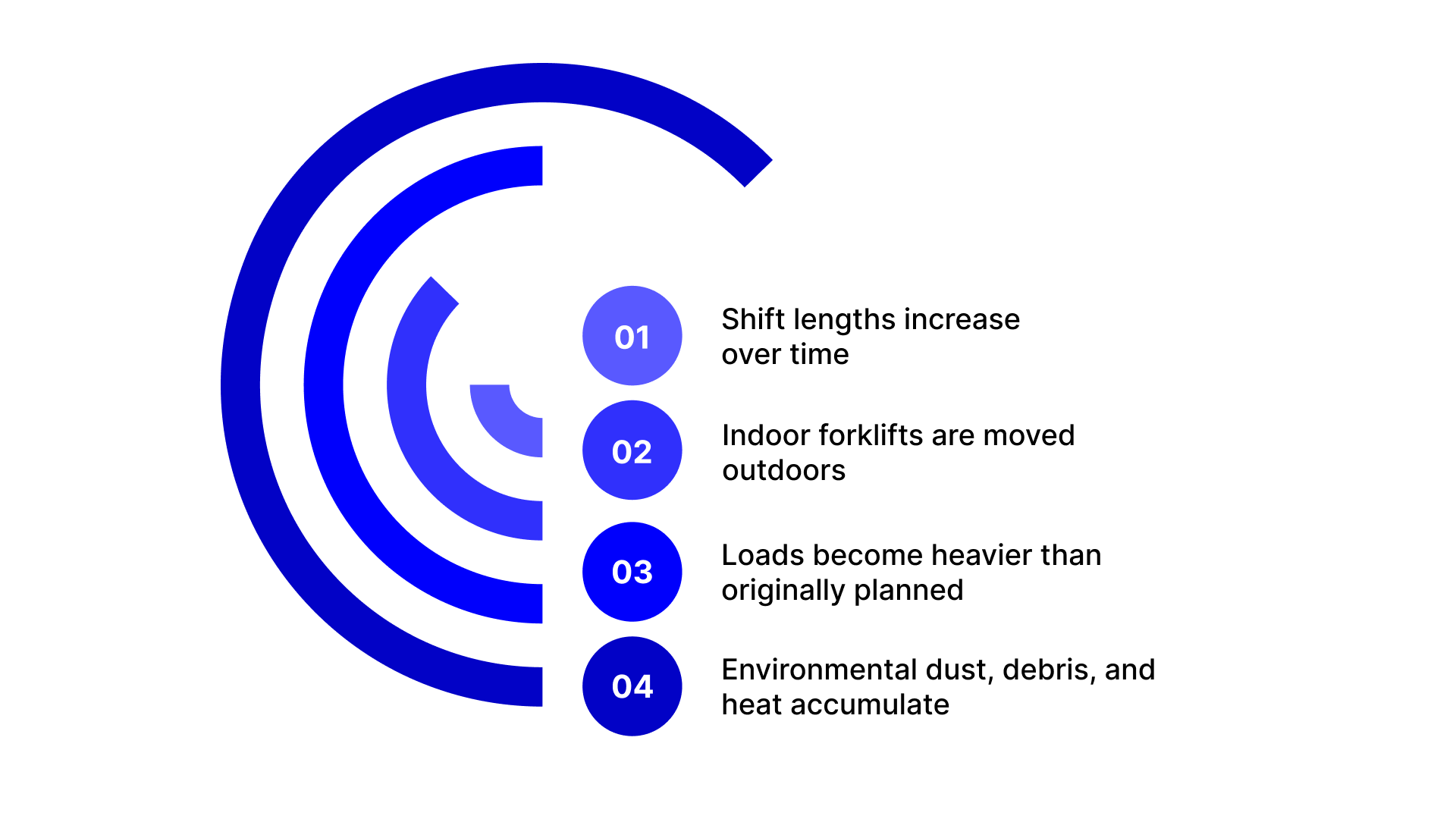
Most overheating issues don’t start with a bad radiator or poor maintenance. They start quietly, as forklifts are asked to do more, for longer, and in tougher conditions than originally planned.
From the buyer’s perspective, the radiator hasn’t failed; the assumptions around its use have changed.
Reframing the problem from real-world operations:
Shift lengths increase over time
Forklifts that once ran single shifts are now expected to operate longer hours, leaving less recovery time for the cooling system.
Indoor forklifts are moved outdoors
Equipment designed for controlled environments is exposed to heat, direct sun, and airflow conditions it was never optimized for.
Loads become heavier than originally planned
As throughput pressure grows, forklifts are routinely pushed closer to their upper working limits, increasing thermal stress.
Environmental dust, debris, and heat accumulate
Yards, construction-adjacent sites, and industrial zones introduce airflow restrictions that steadily reduce cooling effectiveness.
When overheating keeps recurring under changing conditions, the next question becomes unavoidable: is this still a maintenance issue, or is it a radiator design limitation?
Radiator Design vs Maintenance — Where the Line Really Is
For buyers searching for a forklift with good radiator performance, it’s important to separate what routine maintenance can realistically solve from what is determined by radiator design. Maintenance keeps a system running as intended. Design defines how far that system can be pushed before problems begin.
Confusing the two often leads to repeated downtime and unnecessary blame on maintenance teams.
Below is a clear, practical way to distinguish between the two:
If This Is What You’re Seeing… | It Usually Points To… | Why It Matters for Buyers |
Cooling issues return shortly after scheduled upkeep | Design constraints | Maintenance is no longer the controlling variable |
Operators adjust usage to avoid overheating | Cooling misalignment | Productivity is being traded for temperature control |
Downtime clusters during peak hours or hotter periods | Thermal margin limits | The radiator is operating near its ceiling |
Maintenance effort increases without improving stability | Capacity mismatch | More effort is required just to hold the same output |
Forklift performs well early in shifts but degrades later | Heat accumulation | Cooling recovery is insufficient for duty cycle |
Same issue appears across multiple units in similar use | Systemic design issue | Replacing parts individually won’t solve the root cause |
This is the point where buyers stop asking “Are we maintaining it well enough?” and start asking “Is this radiator suited for how we operate today?”
Once it’s clear that repeated overheating isn’t a maintenance failure or a one-off defect, the focus needs to shift away from forklift brands and toward what actually drives cooling performance.
What Buyers Should Evaluate Instead of Forklift Brand Claims
Brand reputation alone does not predict whether a forklift will maintain stable temperatures over time. For buyers focused on uptime and operational risk, radiator performance needs to be evaluated against real working conditions.
The table below helps teams assess cooling fit in a structured, decision-ready way, without relying on marketing claims.
What to Evaluate | What to Ask Internally | Why It Matters for Radiator Performance |
Real duty cycle | How long does the forklift run continuously per shift? | Longer, uninterrupted operation increases heat accumulation |
Operating environment | Is the forklift used indoors, outdoors, or both? | Outdoor heat and poor ventilation reduce cooling recovery |
Ambient temperature exposure | Do peak temperatures coincide with peak workload? | Heat load compounds when demand and temperature rise together |
Air quality and debris levels | How dusty or debris-heavy is the work area? | Restricted airflow degrades radiator effectiveness over time |
Load patterns | Are loads consistent or frequently near upper limits? | Sustained heavy loads generate continuous thermal stress |
Change in usage over time | Has the forklift’s role expanded since purchase? | Radiators remain static while operational demands evolve |
Access for cleaning | How easy is it to inspect and clean airflow paths? | Limited access increases unnoticed clogging risk |
Downtime tolerance | How disruptive is an unplanned thermal shutdown? | High downtime cost elevates cooling reliability to a buying factor |
This evaluation shifts the conversation from “Which brand is best?” to “Which cooling setup fits how we actually operate?”
That mindset helps buyers select forklifts and plan radiator strategies that reduce repeat overheating and protect uptime over the long term.
When cooling risks are clearly tied to usage rather than brand or maintenance gaps, the next decision is not about who to buy from, but what to replace.
When Radiator Replacement Makes More Sense Than Equipment Replacement
At this stage, buyers are not troubleshooting; they are deciding where to intervene. The question is no longer “Can we keep this forklift running?” but “What is actually limiting its reliability?”
This table helps isolate whether the constraint sits with the forklift as a whole or specifically with its cooling system.
Question Buyers Ask | If the Answer Is “Yes”… | What That Signals |
Does the forklift perform normally until temperatures rise? | The issue is isolated to cooling | Replacement can be targeted, not total |
Do overheating incidents follow a predictable pattern? | The constraint is systemic | Design alignment matters more than upkeep |
Has usage intensity increased since purchase? | Cooling demand has changed | Original radiator assumptions no longer hold |
Does cleaning restore airflow but not stability? | Maintenance impact is capped | Design margin has been reached |
Would the forklift be usable if overheating stopped? | Core asset still has value | Full replacement may be premature |
Does equipment replacement create lead-time or budget risk? | Replacement carries disruption | Radiator change reduces exposure |
Is downtime driven more by heat than by mechanical faults? | Cooling is the dominant failure point | Addressing it improves uptime directly |
When most answers point toward cooling rather than mechanical failure, radiator replacement becomes a logical intervention, not a compromise.
Where FSR Products Fit (Forklift Radiator Manufacturing)
At this point in the decision process, buyers are no longer looking for general advice or routine service support. They know overheating is a recurring constraint, and they are evaluating how to correct it at the component level without replacing the entire forklift.
This is where a manufacturing-focused radiator partner becomes relevant.
How FSR Products supports forklift radiator requirements:
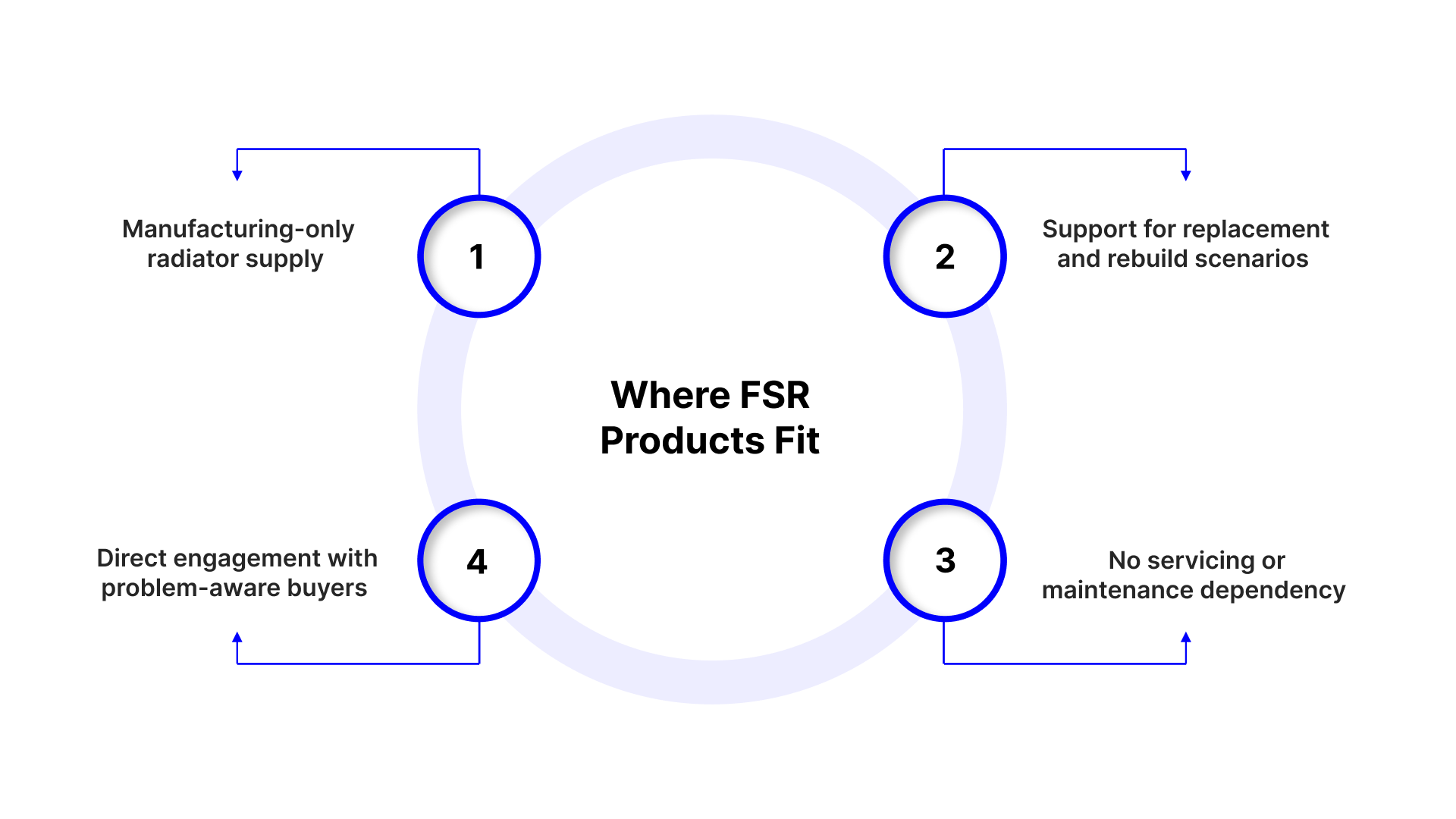
Manufacturing-only radiator supply
FSR focuses exclusively on building radiators—without bundling service, maintenance, or aftermarket contracts that complicate sourcing decisions.
Support for replacement and rebuild scenarios
When an existing forklift remains serviceable but cooling performance no longer holds up, FSR supports radiator replacement or rebuild paths aligned with current operating conditions.
No servicing or maintenance dependency
Buyers are not locked into ongoing service agreements. FSR’s role ends at manufacturing and supply, keeping responsibilities clearly defined.
Direct engagement with problem-aware buyers
FSR works with procurement, engineering, and operations teams that have already identified overheating as a design or alignment issue, not a routine maintenance task.
What buyers typically provide to start the conversation:
Forklift make and model
Existing radiator reference or configuration
A brief summary of the operating environment and usage conditions
For forklifts limited by recurring overheating, FSR Products can be engaged to assess radiator replacement feasibility.
Wrapping Up
Choosing a forklift with good radiator performance is less about brand reputation and more about long-term cooling alignment. Buyers who recognize this early avoid reactive decisions and regain control over uptime, cost, and planning.
As a manufacturing-only supplier, FSR Products supports this decision by focusing on radiator build and replacement, without adding service dependencies or unnecessary complexity.
To evaluate radiator replacement for your forklift, contact FSR Products.
FAQs
1. Why does a forklift with good radiator still struggle during peak operations?
Even when a forklift has a good radiator, peak workloads often combine longer run times, higher loads, and hotter conditions. These overlaps create thermal stress that wasn’t part of the original operating assumptions.
2. Can radiator issues affect forklift productivity before visible overheating occurs?
Yes. Early signs often show up as reduced shift flexibility, forced idle periods, or operator workarounds—well before alarms or shutdowns appear.
3. How early should radiator performance factor into forklift lifecycle planning?
Radiator performance should be reviewed whenever usage intensity changes. Waiting until overheating becomes frequent usually means the operation has already absorbed avoidable downtime.
4. Does upgrading to a newer forklift always solve cooling problems?
Not necessarily. A newer forklift can face the same issues if its radiator is not aligned with the actual environment and duty cycle it’s placed into.
5. Is radiator replacement a temporary fix or a long-term solution?
When matched correctly to current operating conditions, radiator replacement can restore stable performance and extend the usable life of a forklift with good radiator alignment.
6. What information do buyers typically overlook when assessing forklift radiator problems?
Most focus on the forklift model, but overlook how usage has evolved—shift length, heat exposure, debris levels—which often explains why a good radiator no longer performs as expected.