A baggage tug that won’t start doesn’t just cause a minor delay; it can cascade into late bags, idle crews, and disrupted ramp operations. And more often than many teams expect, the problem traces back to a critical but overlooked component: the fuel tank.
In ground support equipment like baggage tugs, belt loaders, pushbacks, and forklifts, fuel tanks sit at the crossroads of uptime and safety. Cracks, leaks, contamination, or venting failures can lead to hard starts, unexpected shutdowns, fuel spills, and serious fire risk in one of the most demanding work environments in aviation.
This blog breaks down the true cost of fuel tank replacement, from obvious expenses to hidden cost drivers like downtime and rework. We’ll also cover why quality, correctly engineered fuel tanks play a key role in keeping GSE reliable, compliant, and ready for daily operations.
Key highlights:
Fuel tanks are a major hidden cause of GSE failures, leading to leaks, shutdowns, and operational delays on the ramp.
Replacement costs depend on tank material, custom fitment, capacity, and fuel type, since GSE tanks are built for heavy-duty use.
Labor and downtime add heavily to total cost, with tight chassis access and essential safety checks extending installation time.
Repairs work only for minor issues, while corrosion, cracks, or recurring failures make full replacement more reliable and cost-effective.
FSR Products offers equipment-specific fuel tanks, ensuring proper fit, durability, and reduced downtime for key GSE assets.
What Is a Fuel Tank for GSE & Industrial Equipment?
A fuel tank for ground support equipment (GSE) and industrial equipment is a purpose-built container designed to safely store and deliver diesel or gasoline to an engine under demanding operating conditions. Unlike passive storage, these tanks are an active part of the fuel system, supplying consistent flow, managing pressure and ventilation, and helping keep fuel clean and usable across long operating hours.
Core Functions of a GSE Fuel Tank
A properly engineered fuel tank does more than hold fuel:
Fuel storage: Safely contains diesel or gasoline while resisting vibration, impact, and environmental exposure
Fuel delivery: Feeds the engine through pumps and lines without interruption, even during frequent starts and stops
Ventilation & pressure control: Prevents vapor lock and pressure buildup through proper venting
System integration: Houses senders, pickups, returns, and mounting points that align with the equipment’s design
In airport and industrial environments where equipment runs daily and often idles for long periods, fuel tank reliability directly affects uptime and safety.
How GSE Fuel Tanks Differ From Consumer Vehicle Tanks
Fuel tanks used in GSE and industrial equipment are not interchangeable with automotive fuel tanks. Key differences include:
Heavier-duty construction: Built from thicker steel or industrial-grade polymers to handle vibration, impacts, and harsh ramp conditions
Larger capacities: Designed for extended operating shifts with fewer refueling interruptions
Custom-fit designs: Shaped and mounted to fit specific equipment frames, not standardized vehicle chassis
Industrial components: Engineered to support external pumps, return lines, level senders, and compliance requirements
Because these tanks are designed around equipment-specific layouts and workloads, using the correct fuel tank is critical, not just for performance, but for safety, compliance, and long-term operating cost control.
5 Key Factors That Determine Fuel Tank Replacement Cost
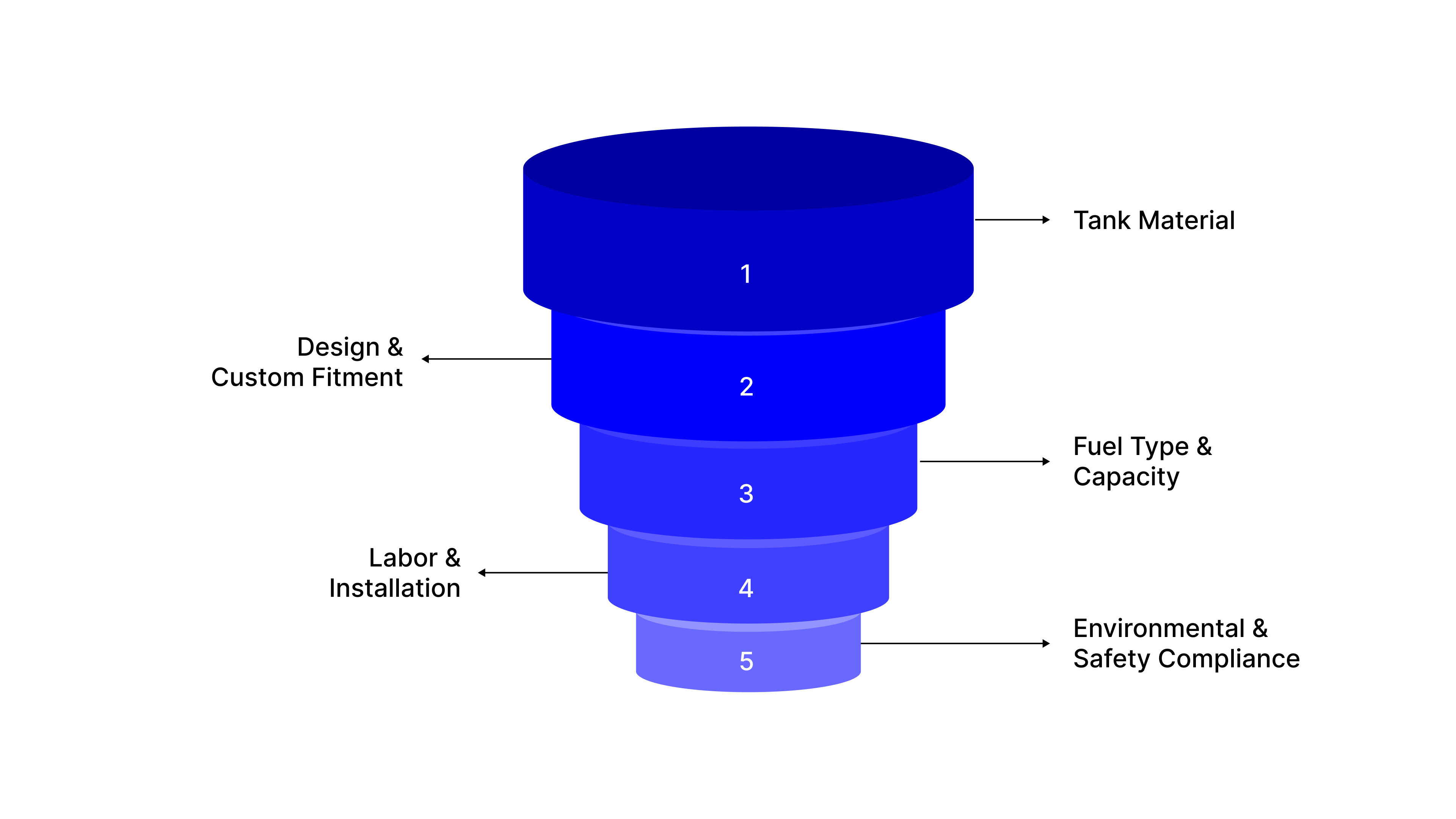
Fuel tank replacement pricing can feel unpredictable, but it’s not random. Several specific factors drive cost, especially for GSE and industrial equipment. Understanding these variables helps explain why prices vary and why industrial tanks cost more than basic automotive equivalents.
1. Tank Material
Material choice has a major impact on both price and lifespan.
Steel tanks offer high strength and impact resistance, making them common in heavy-duty GSE. Thicker-gauge steel increases durability but also raises material and fabrication costs.
Aluminum tanks provide corrosion resistance and a lighter weight, often at a higher upfront cost.
Composite or welded industrial tanks are engineered for vibration and harsh environments, balancing durability with long-term corrosion control.
Heavier-duty equipment typically requires thicker materials, is more expensive upfront, but often cheaper over time due to longer service life.
2. Design & Custom Fitment
Unlike automotive fuel tanks, GSE fuel tanks must match specific chassis layouts, mounting points, and clearances.
Custom shapes to fit tight frames
Reinforced mounting tabs and brackets
Integrated ports for senders, returns, and vents
Custom fabrication significantly increases cost compared to off-the-shelf tanks, but it ensures proper fit, safety, and reliability.
3. Fuel Type & Capacity
Fuel characteristics and volume also affect pricing:
Diesel tanks often require heavier construction due to weight and duty cycles
Gasoline tanks may need additional vapor control considerations
Larger-capacity tanks use more material, require stronger mounts, and involve more complex fabrication
Higher capacity means fewer refueling stops, but higher manufacturing and installation costs.
4. Labor & Installation
Replacement isn’t just a swap-and-go job.
Removal of the old tank (often contaminated or corroded)
Working within tight chassis spaces common on tugs and loaders
Reconnecting fuel lines, pumps, senders, vents, and returns
Performing leak checks and operational testing
Labor time and complexity can rival or exceed the cost of the tank itself.
5. Environmental & Safety Compliance
Fuel systems must meet strict safety and environmental expectations, especially in airport and industrial settings.
Spill prevention and containment measures
Proper venting and sealing
Inspection, testing, and documentation
Compliance steps add cost, but skipping them increases risk, liability, and downtime.
Typical Fuel Tank Replacement Cost Ranges
These ranges reflect real-world GSE conditions and help maintenance teams budget more accurately by accounting for industrial-grade parts, labor, and installation complexity.
Equipment Size | Common GSE Types | Parts Characteristics | Installation Complexity | Typical Cost Range |
|---|---|---|---|---|
Small GSE | Baggage tugs, light belt loaders, utility forklifts | Custom-fit tanks, thicker materials than automotive, welded construction, corrosion-resistant options | Moderate labor; access varies by chassis; includes removal, fuel system reconnections, and leak testing | Low thousands, increasing with custom fabrication or corrosion damage |
Large GSE | Pushback tractors, cargo loaders, heavy-duty tow vehicles | Large-capacity tanks, heavy-gauge steel or reinforced aluminum, complex mounts | High labor; tight chassis spaces, lifting equipment required, additional safety procedures, and inspections | Several thousand to well into five figures, depending on size, material, and compliance |
Fuel tank replacement costs increase with equipment size, duty cycle, and safety requirements. Larger GSE demands heavier materials, more complex fabrication, longer installation time, and stricter compliance, all of which significantly affect total cost.
Cost Breakdown: Parts vs. Labor vs. Downtime
Fuel tank replacement costs are rarely driven by a single line item. The true expense comes from how parts, labor, and operational downtime combine during the replacement process.
a. Parts
The fuel tank itself is only the starting point.
For GSE and industrial equipment, parts costs are higher because tanks are built for specific chassis layouts, heavier loads, and continuous use. Material choice, tank capacity, and custom fabrication all influence price. In addition to the tank, replacement often includes mounting straps, brackets, gaskets, seals, caps, vents, and fuel level sensors.
Unlike automotive applications, many GSE tanks are custom or semi-custom, which increases cost but ensures proper fit, structural strength, and long-term reliability.
b. Labor
Labor costs can rivalor exceed the price of the tank.
Removing and installing a fuel tank on GSE typically requires multiple hours of work by technicians experienced with heavy equipment. Tight chassis spaces, safe fuel handling procedures, and careful reconnection of pumps, lines, and sensors add complexity. Final leak checks and system testing are essential steps that also factor into total labor time.
c. Downtime Costs
Downtime is often the most expensive and least visible part of fuel tank replacement.
When critical ground support equipment is out of service, the impact goes beyond maintenance. Delayed baggage handling, slower aircraft turnarounds, and the need to reassign or rent equipment create real operational costs. In busy airport environments, even short periods of downtime can ripple across multiple flights.
The real cost of fuel tank replacement isn’t just the part; it’s the combination of parts, labor, and lost productivity.
Repair vs. Replacement: Which Is More Cost-Effective?
Choosing between repair and replacement is easiest when the trade-offs are clearly compared side by side.
Factor | Repair | Replacement |
|---|---|---|
Best Use Case | Minor, isolated issues | Structural damage or recurring failures |
Typical Issues Addressed | Worn seals, loose fittings, surface corrosion, small non-structural leaks | Cracks, thinning metal, internal contamination, repeated leaks |
Upfront Cost | Lower initial expense | Higher initial investment |
Downtime | Shorter, if the repair is straightforward | Longer, due to removal and installation |
Long-Term Reliability | Limited; depends on tank condition | High: restores full system integrity |
Safety & Compliance | Acceptable only if the structure is sound | Meets current safety and environmental standards |
Risk of Repeat Failure | Moderate to high | Low |
Total Cost Over Time | Often higher due to repeat labor and downtime | Lower due to fewer failures and repairs |
Repairs can make sense for minor, clearly defined problems when the tank’s structure is still sound.
Signs You Should Replace a Fuel Tank Soon
Recognizing early warning signs helps prevent unplanned failures, safety risks, and costly downtime.
Fuel leaks or strong odors: Any visible leak, fuel staining, or persistent fuel smell indicates compromised containment and should be addressed immediately. Even small leaks can escalate into safety and environmental hazards.
Visible corrosion or cracks: Rust, pitting, thinning metal, or hairline cracks weaken the tank’s structure. Once corrosion becomes visible, internal damage is often more advanced than it appears.
Reduced fuel efficiency: Unexplained drops in fuel efficiency may signal leaks, contamination, or restricted fuel flow caused by internal tank deterioration.
Repeated fuel system issues: Frequent problems such as clogged filters, failing pumps, or inaccurate fuel level readings often point to internal contamination or degradation within the tank.
Failed inspections: Tanks that fail safety, environmental, or operational inspections typically require replacement rather than repair to meet compliance standards.
If one or more of these signs appear, replacement is usually the safest course of action. Acting early helps avoid emergency repairs, operational disruption, and higher total replacement costs later.
How to Reduce Long-Term Fuel Tank Replacement Costs
The most effective way to control fuel tank costs isn’t cutting corners, it’s making smarter decisions upfront.
Choose durable fuel tank materials over the lowest upfront-cost options, as heavier-gauge steel, aluminum, or industrial-grade composites last longer and reduce repeat replacements, labor costs, and downtime.
Prioritize corrosion resistance for equipment operating outdoors or in high-humidity environments, since corrosion is a primary cause of premature fuel tank failure in industrial and GSE applications.
Ensure proper fitment and mounting by using tanks designed specifically for the equipment chassis, as correct mounting points and load distribution reduce vibration, cracking, and safety risks.
Use fuel tanks engineered for heavy-duty or continuous operation, since frequent start-stop cycles, idling, and long run times place higher stress on tanks than standard automotive use.
Avoid automotive-style fuel tanks in industrial or airport environments, as they are not designed to handle the duty cycles, vibration, and operational demands of ground support equipment.
Follow preventive maintenance best practices by inspecting tanks regularly, addressing minor issues early, maintaining fuel quality, and replacing seals and vents proactively to avoid unexpected failures.
Lower long-term fuel tank costs come from engineering-driven choices, not price-driven ones.
Choosing the Right Fuel Tank for Your Application
Choosing the right fuel tank is a technical decision that directly affects safety, reliability, and operating cost. The wrong choice usually shows up as repeat leaks, mounting failures, or unplanned downtime.
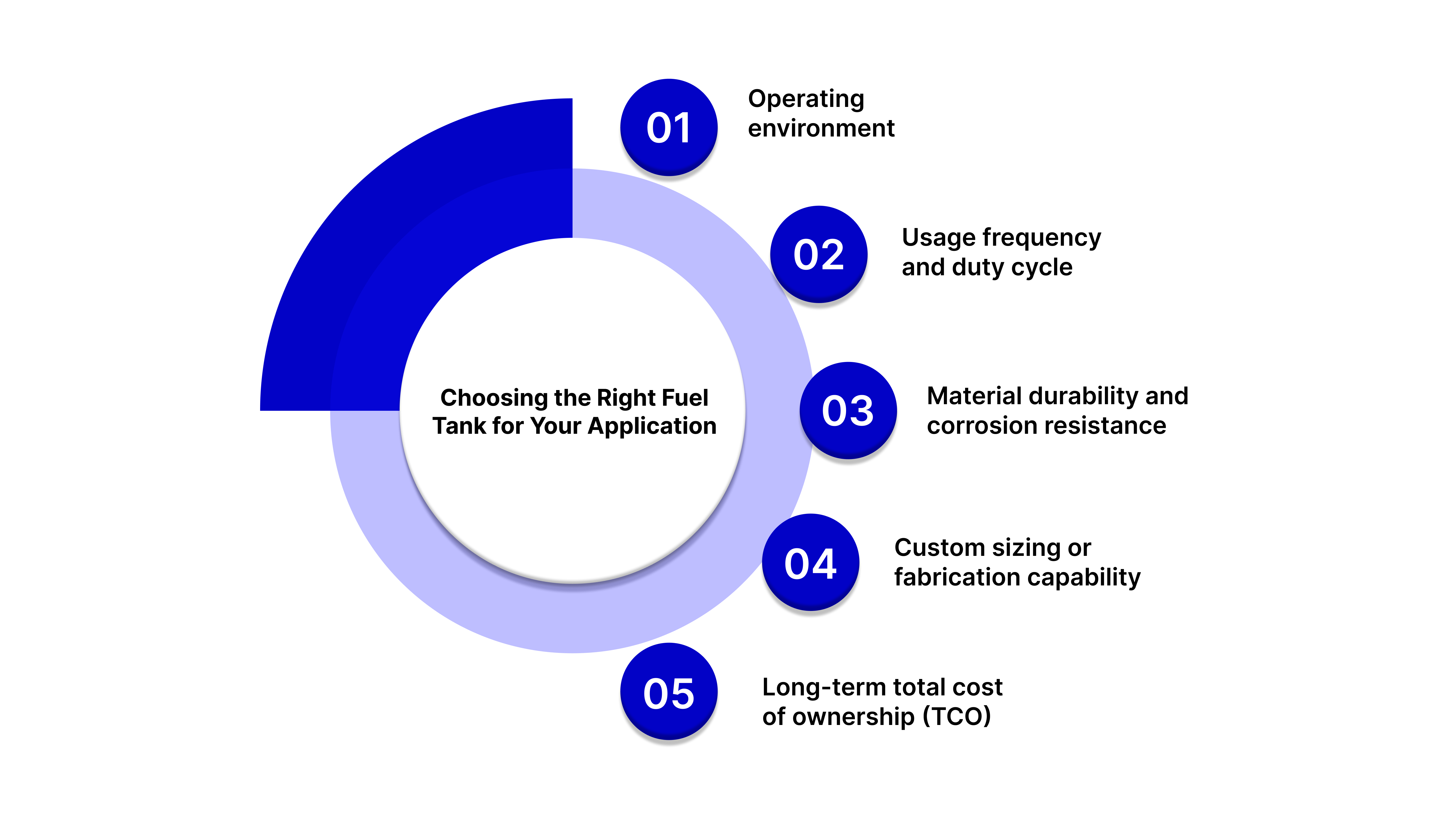
Operating environment: Tanks used in high-heat, high-vibration, or outdoor environments must handle thermal expansion, constant mechanical stress, moisture, and corrosion. Materials, wall thickness, coatings, and weld quality should match these conditions to prevent cracking and premature failure.
Usage frequency and duty cycle: Equipment running daily or across multiple shifts places continuous stress on the fuel system. High-duty-cycle applications require tanks designed for constant fuel movement, repeated pressure changes, and long service intervals.
Material durability and corrosion resistance: Steel, aluminum, and composite tanks behave differently over time. The correct material choice reduces internal contamination, external corrosion, and structural fatigue based on how and where the equipment operates.
Custom sizing or fabrication capability: Tanks that are forced to fit create stress at mounts, seams, and fuel connections. Properly sized or custom-fabricated tanks align with the chassis, support correct mounting geometry, and reduce vibration-related failures.
Long-term total cost of ownership (TCO): The lowest upfront price often leads to higher lifetime cost through repeat replacements, added labor, and downtime. Evaluating expected service life, maintenance needs, and operational impact provides a more accurate cost comparison.
A fuel tank matched to environment, workload, and fitment requirements delivers fewer failures, longer service life, and lower total operating cost over the equipment’s lifecycle.
How Does FSR Products Support Fuel Tank Replacement for GSE?
FSR Products supports fuel tank replacement needs by focusing on application-specific solutions for ground support equipment, rather than one-size-fits-all parts.
Supplies fuel tanks and fuel cells for core GSE assets such as baggage tugs, belt loaders, ground power units, cargo loaders, forklifts, and pushback tractors
Emphasizes model-specific replacements, helping maintenance teams avoid custom fabrication, forced fitment, and rework
Offers industrial-grade fuel solutions, including corrosion-resistant aluminum fuel cells in certain applications, suitable for outdoor and high-use environments
Aligns products with real GSE operating conditions, where vibration, long duty cycles, and frequent refueling place higher demands on fuel systems
Helps operators reduce the total cost of ownership by minimizing repeat failures, unplanned downtime, and installation inefficiencies
FSR Products is positioned for GSE operators who value correct fitment, durability, and predictable performance when replacing fuel tanks in demanding airport operations.
Conclusion
Fuel tank replacement costs vary widely based on equipment size, tank material, fitment, labor complexity, downtime, and compliance requirements. Looking only at part price rarely reflects the true cost over time.
Planning fuel tank replacement as part of fleet maintenance and budgeting helps GSE operators reduce risk, control downtime, and avoid reactive repairs. Choosing durable, properly fitted tanks supports long-term reliability and safer ground operations.
If you’re planning a replacement or evaluating options, FSR Products offers equipment-specific fuel tanks and fuel system solutions built for GSE environments.
Contact FSR Products to discuss the right fuel tank solution for your operation.
FAQ
1. How long does a GSE fuel tank typically last?
Service life depends on material, environment, and duty cycle. In high-use airport conditions, corrosion and vibration often shorten the lifespan compared to light industrial use.
2. Can a fuel tank be repaired instead of replaced?
Minor issues like seals or fittings may be repairable. Structural corrosion, cracks, or recurring leaks usually make replacement the safer and more economical option.
3. Why are GSE fuel tanks more expensive than automotive tanks?
GSE tanks are built for heavier use, custom fitment, and safety compliance. Thicker materials, welded construction, and model-specific designs increase cost but improve reliability.
4. How much downtime should I expect during replacement?
Downtime varies by equipment size and access. Small GSE may be offline briefly, while large loaders or pushbacks often require longer, planned outages.
5. Does tank material really affect long-term cost?
Yes. Choosing corrosion-resistant, heavy-duty materials reduces repeat failures, labor costs, and unplanned downtime—lowering the total cost of ownership.