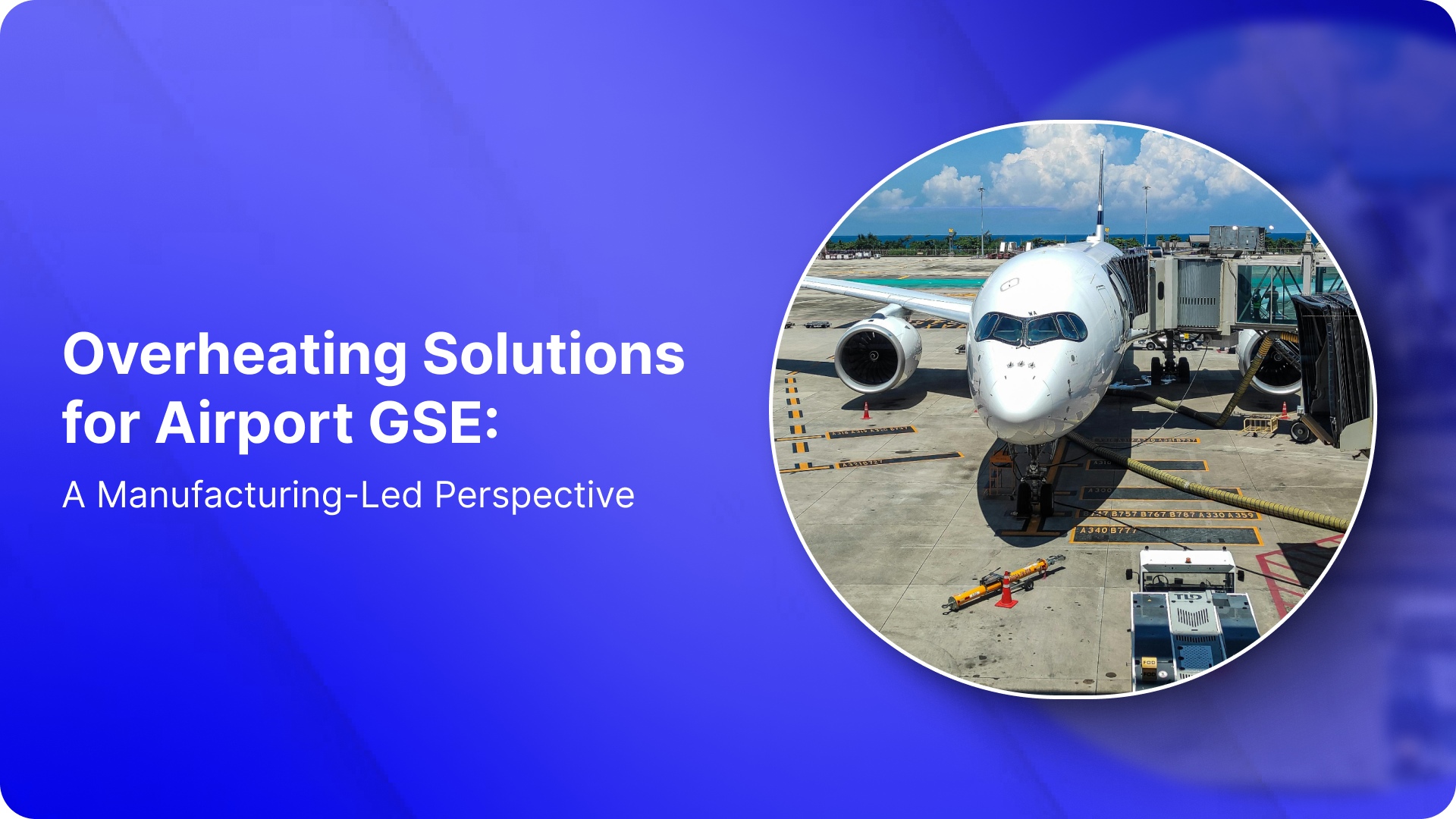
Airport GSE overheating rarely announces itself as a big problem. It shows up as a delay. Then, a piece of equipment that suddenly can’t stay online during the busiest part of the day.
When ground support equipment overheats, aircraft don’t turn on time. Backup units get pulled in. Operations teams scramble. And these incidents almost always cluster during peak shifts, when there’s no margin to absorb failure.
The usual response is repair. Service it. Patch it. Get it back out there. It works, briefly. Then the same overheating returns, often across multiple units, because the root issue was never operational. It was built in.
That’s why effective overheating solutions for airport GSE start earlier than maintenance.
This guide breaks down where overheating actually begins and how airport and OEM teams can address it before it becomes a recurring operational risk.
At a Glance:
Operational Impact Is Immediate: Overheating solutions for airport GSE directly affect equipment availability during peak shifts and aircraft turnaround windows.
Patterns Matter More Than Incidents: Repeated overheating under similar operating conditions usually signals a structural limitation, not isolated failure.
Repairs Don’t Always Scale: Servicing can restore short-term availability, but recurring overheating often requires replacement or build-level intervention.
Manufacturing Decisions Reduce Risk: Aligning radiator builds with real airport operating conditions supports more predictable fleet planning and reduces operational pressure.
Why Overheating Keeps Coming Back in Airport GSE
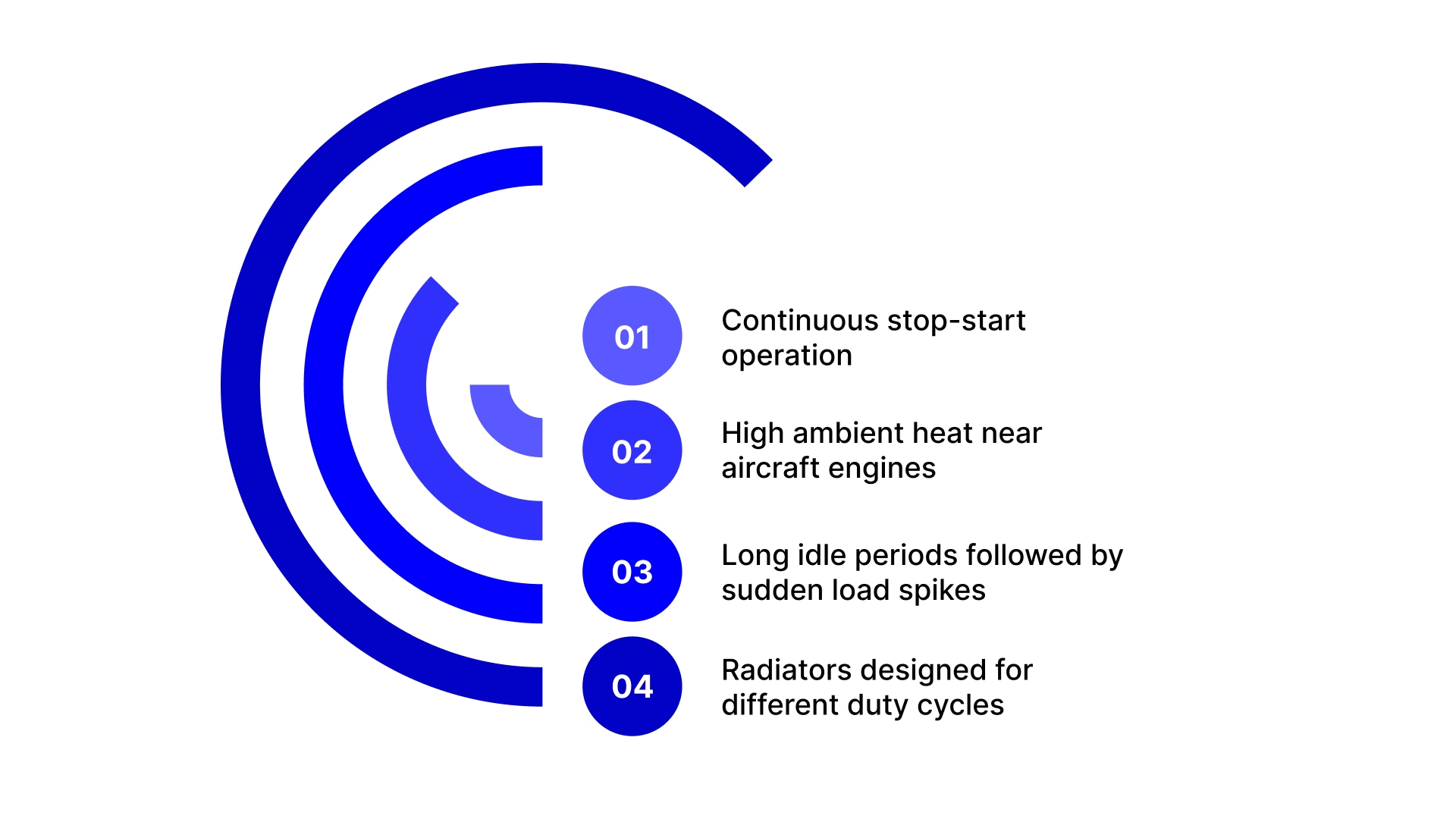
Overheating in airport GSE keeps returning because the equipment is used in ways many cooling systems were never designed for.
Ground support equipment sits idle, then works at full load, often in high ambient heat near active aircraft. These uneven operating cycles put stress on radiators built around different assumptions.
When overheating repeats in this environment, it is rarely a one-off fault. It usually points to a mismatch between real-world ramp conditions and the original radiator design, something temporary fixes can manage, but not eliminate.
The most common contributors include:
Continuous stop-start operation
GSE rarely runs at steady, predictable loads. Frequent starts, stops, and short cycles limit thermal recovery time, especially during busy turnaround windows.
High ambient heat near aircraft engines
Equipment operates close to active aircraft, where surrounding heat is already elevated before the GSE begins its own work cycle.
Long idle periods followed by sudden load spikes
Extended idle time can be followed by immediate, heavy use, creating sharp thermal swings rather than gradual ramp-ups.
Radiators designed for different duty cycles
Many cooling systems are built around operating assumptions that don’t fully reflect airport ramp realities, especially as usage patterns evolve over time.
When this mismatch persists, overheating stops being an engineering concern and becomes a procurement problem. These patterns introduce familiar procurement pressures:
Escalating downtime during peak periods
Unpredictable lead times for replacements
Growing reliance on a limited set of vendors
Bottlenecks that ripple beyond a single piece of equipment
At this stage, overheating is about whether the cooling system was ever aligned with how the fleet is expected to perform.
Common “Fixes” That Don’t Solve the Root Cause
When overheating starts affecting operations, the first response is usually corrective, not structural. The goal is to get equipment back into service as quickly as possible.
Common actions include:
More frequent coolant replacement
Temporary airflow or ventilation adjustments
Operator-level workarounds to reduce load
Short-term service interventions to restore availability
In isolation, these steps can help stabilize equipment in the moment. They are practical and often necessary. The limitation is scale. Across a fleet, these approaches focus on managing symptoms, not addressing the conditions that cause overheating to return.
When the same fixes are applied repeatedly, it’s often a sign that the cooling system itself is being asked to operate outside its original assumptions.
Manufacturing-Led Overheating Solutions
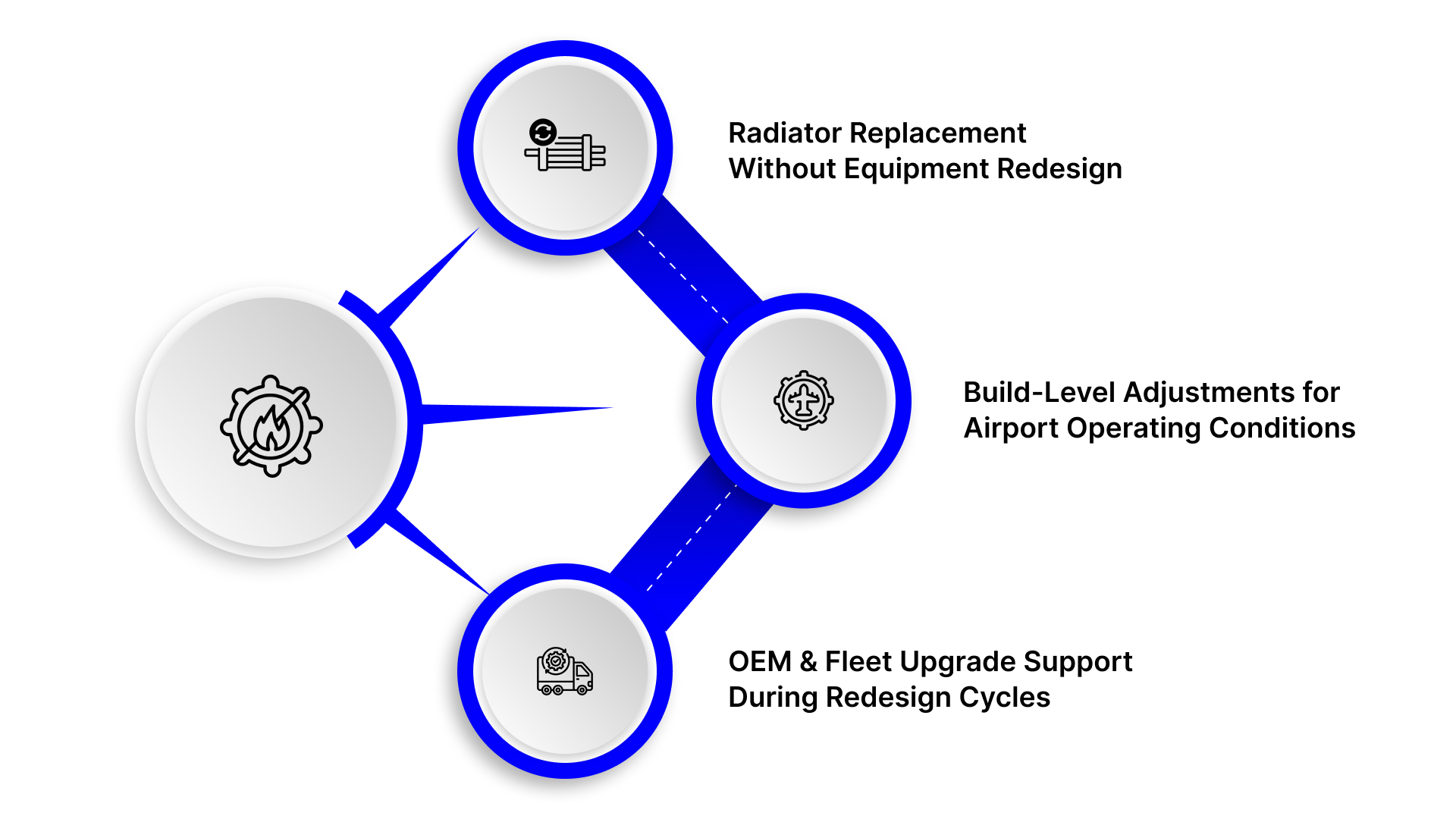
At some point, repeating the same fixes stops making sense. Not because teams aren’t responding fast enough, but because the equipment keeps returning to the same failure point.
A manufacturing-led approach looks at overheating from a different angle. Instead of asking how to recover after shutdowns, it asks whether the cooling system was ever aligned with real ramp conditions in the first place. That shift opens up options that servicing cannot.
Below are the solution paths organizations consider when overheating becomes predictable rather than occasional.
1. Radiator Replacement Without Equipment Redesign
This path is chosen when overheating is repeatable, but the equipment itself still meets operational needs.
Typically considered when:
The same GSE units overheat after multiple service cycles
Similar equipment shows the same behavior under peak use
Downtime planning becomes reactive instead of predictable
Why replacement works in these cases:
Addresses cooling limitations without changing the full equipment design
Supports consistent performance across the fleet
Reduces dependency on operator workarounds and emergency servicing
What this approach avoids:
Long redesign cycles
Equipment replacement costs
Disruption to existing approvals and layouts
For airport operators and OEMs evaluating overheating solutions for airport GSE, radiator replacement at the manufacturing level is often the first step when repairs no longer scale.
If recurring overheating is affecting multiple units, discussing replacement radiator builds with FSR Products can help clarify whether design alignment, not servicing, is the real constraint.
2. Build-Level Adjustments for Airport Operating Conditions
This path comes into play when overheating is no longer isolated; it is predictable across the same equipment types and operating windows.
Typically considered when:
Overheating occurs during specific shifts or peak turnaround periods
Multiple units show the same thermal behavior
Operational teams rely on repeat workarounds to stay online
What build-level adjustment focuses on:
Aligning radiator builds with stop-start ramp usage
Accounting for high ambient heat near aircraft operations
Reducing thermal stress caused by uneven load cycles
Why this matters at scale:
Supports more stable fleet availability
Reduces unplanned equipment rotation
Limits operational bottlenecks during peak periods
3. OEM & Fleet Upgrade Support During Redesign Cycles
This path applies when overheating surfaces during planned change, not unexpected failure.
It is most relevant during:
Fleet expansion or replacement programs
Mid-life equipment upgrades
OEM redesign or platform refresh cycles
Why cooling decisions matter at this stage:
Design assumptions are already being revisited
Addressing overheating early reduces downstream operational risk
Cooling alignment supports long-term uptime planning
What manufacturing support enables:
Radiator builds aligned with updated operating expectations
Fewer corrective actions after deployment
More predictable fleet performance over time
For OEMs and airport operators planning future-ready overheating solutions for airport GSE, this stage offers the clearest opportunity to address cooling at the source.
At this stage, the decision is no longer about fixing symptoms, but about knowing when a radiator rebuild makes sense.
When Should Airports or OEMs Consider a Radiator Rebuild?
A radiator rebuild should be considered when overheating stops being an occasional disruption and starts shaping how the fleet is planned, rotated, and supported.
Instead of tracking individual incidents, ask these questions:
Are we planning around overheating instead of expecting reliability?
If schedules, shift planning, or equipment assignments already assume certain units may not stay online, the issue has moved beyond maintenance.
Have corrective actions stopped changing outcomes?
When servicing restores availability only temporarily, the constraint is no longer effort or response time, it’s system capability.
Would replacing the radiator reduce uncertainty more than continuing repairs?
If a rebuild offers clearer planning stability than ongoing fixes, the decision becomes operational, not technical.
When the answer to these questions trends toward “yes,” overheating is no longer a fault to manage. It’s a design-alignment issue.
That is typically the point where engaging a radiator manufacturer to evaluate a rebuild becomes a rational next step, not as a purchase decision, but as a validation exercise.
How FSR Products Fits Into Airport GSE Overheating Decisions
When overheating persists, airport teams are usually not looking for more servicing. They are trying to understand whether the radiator itself is still fit for how the equipment is used.
That is where FSR Products fits.
FSR operates strictly as a radiator manufacturer, supporting airport ground support equipment through replacement and build-level alignment, without entering the maintenance or service layer.
FSR’s role is typically relevant when:
Equipment remains in service, but overheating keeps returning
Replacement is preferred over redesign or equipment change
Procurement needs a clear manufacturing path, not a service contract
What FSR provides:
Radiator builds intended for direct replacement in existing GSE
Manufacturing alignment based on real airport operating patterns
Supply support for fleet-level consistency and planning
By keeping manufacturing separate from maintenance execution, FSR allows airport operators and OEMs to address overheating at the component level.
Conclusion
Long-term overheating solutions for airport GSE are less about urgency and more about timing. Knowing when to step back and address the cooling system itself, before overheating, dictates operational decisions.
By focusing solely on the manufacturing and supply of radiators for airport ground support equipment, FSR Products supports this earlier decision point.
If your team is evaluating repeat overheating, replacement readiness, or supplier alignment, an early manufacturing discussion can reduce pressure when operational windows are tight.
Visit the Contact Us page to connect with FSR Products.
FAQs
1. How do we know if overheating is a design issue or just an operational one?
If overheating patterns remain consistent despite changes in operators, shifts, or maintenance effort, the issue is usually structural. Operational factors may trigger the event, but design alignment determines whether it keeps returning.
2. Can overheating solutions for airport GSE be addressed without changing approved equipment configurations?
In many cases, yes. When the equipment itself remains compliant and fit for use, addressing overheating through radiator replacement or rebuilds can be a lower-disruption option than full system changes.
3. Why does overheating often appear after years of “normal” operation?
Operating conditions evolve. Increased traffic, tighter turnaround windows, different aircraft mixes, or heavier utilization can gradually push cooling systems beyond what they were originally built to handle.
4. Does replacing a radiator automatically mean redesigning the entire cooling system?
No. Replacement and redesign are not the same decision. Many organizations first evaluate whether a radiator build can be better aligned to current usage before considering broader system changes.
5. How does recurring overheating affect long-term supplier risk?
When overheating becomes routine, teams often grow dependent on rapid fixes or limited suppliers. Over time, this reduces flexibility and increases exposure to lead-time and availability constraints.