
A quote for a radiator is rarely the real number. What fleets often discover later is that the semi truck radiator replacement cost grows once labor complexity, add-on parts, and downtime exposure enter the picture.
Access issues can extend shop time. Related components are often replaced mid-job. And if the failure happens on the road, towing and lost dispatch capacity quickly outweigh the cost of the radiator itself. None of this is obvious from an initial estimate.
That’s why replacement decisions based only on “average cost” tend to miss what actually affects budgets and fleet availability.
This guide breaks down what goes into the real replacement cost, why pricing varies so widely, and how to scope the job correctly before committing.
Quick Take:
Replacement Cost Is More Than the Part: Semi truck radiator replacement cost is shaped by labor scope, downtime exposure, and sourcing decisions—not just the radiator itself.
Unplanned Work Drives Cost Spikes: Roadside failures, unclear quotes, and backordered parts are what make replacement costs escalate.
Planning Reduces Variability: Planned replacements with clear scope and sourcing paths are easier to budget and schedule than reactive fixes.
Manufacturing Matters at Scale: When replacements repeat across units, manufacturing-led sourcing helps improve availability and cost predictability.
What “Replacement Cost” Actually Includes
When people talk about semi truck radiator replacement cost, they often mean the price of the radiator itself. In practice, that number is only one part of the total exposure.
Replacement cost is better understood as everything required to return the truck to reliable service. Some items are obvious at quote stage. Others surface only once work begins, or once the truck is already off the road.
Understanding these components upfront is what separates a controlled replacement from a reactive one.
Radiator part: The replacement unit itself, whether sourced as a standard replacement or through a manufacturing supplier.
Labor scope and access complexity: Time and effort required to remove and reinstall the radiator based on how the truck is packaged.
Related fluids and small components: Items commonly replaced during the job to restore system integrity, often identified after teardown.
Diagnostic time: Additional time if overheating or failure cause is not immediately clear.
Towing or roadside recovery risk: Relevant when failure occurs in transit rather than during planned maintenance.
Downtime and lost dispatch capacity: Revenue impact while the truck is unavailable, especially for time-sensitive routes.
Scheduling disruption: Knock-on effects on drivers, loads, and backup equipment.
Even with a clear checklist, many replacement jobs still end up costing more than expected. That’s usually because quotes focus on what’s visible at the start, while other cost drivers only appear once the truck is already down.
The table below highlights where that gap typically shows up.
What you pay for upfront | What buyers often overlook |
Replacement radiator | Whether the radiator is a direct fit or requires extra handling |
Quoted labor time | Access constraints that extend removal and installation |
Basic fluid replacement | Additional small components identified during teardown |
Planned shop work | Diagnostic time if failure cause isn’t immediately clear |
Standard repair visit | Towing or recovery if failure occurs in transit |
Job completion time | Downtime impact on dispatch schedules and route coverage |
Single-unit repair | Repeat exposure across similar trucks in the fleet |
This gap between quoted cost and actual exposure is why radiator replacement decisions benefit from scoping beyond the part itself.
What actually determines the final replacement cost is not the radiator alone, but a small set of variables that compound quickly.
The 7 Real Drivers of Semi Truck Radiator Replacement Cost
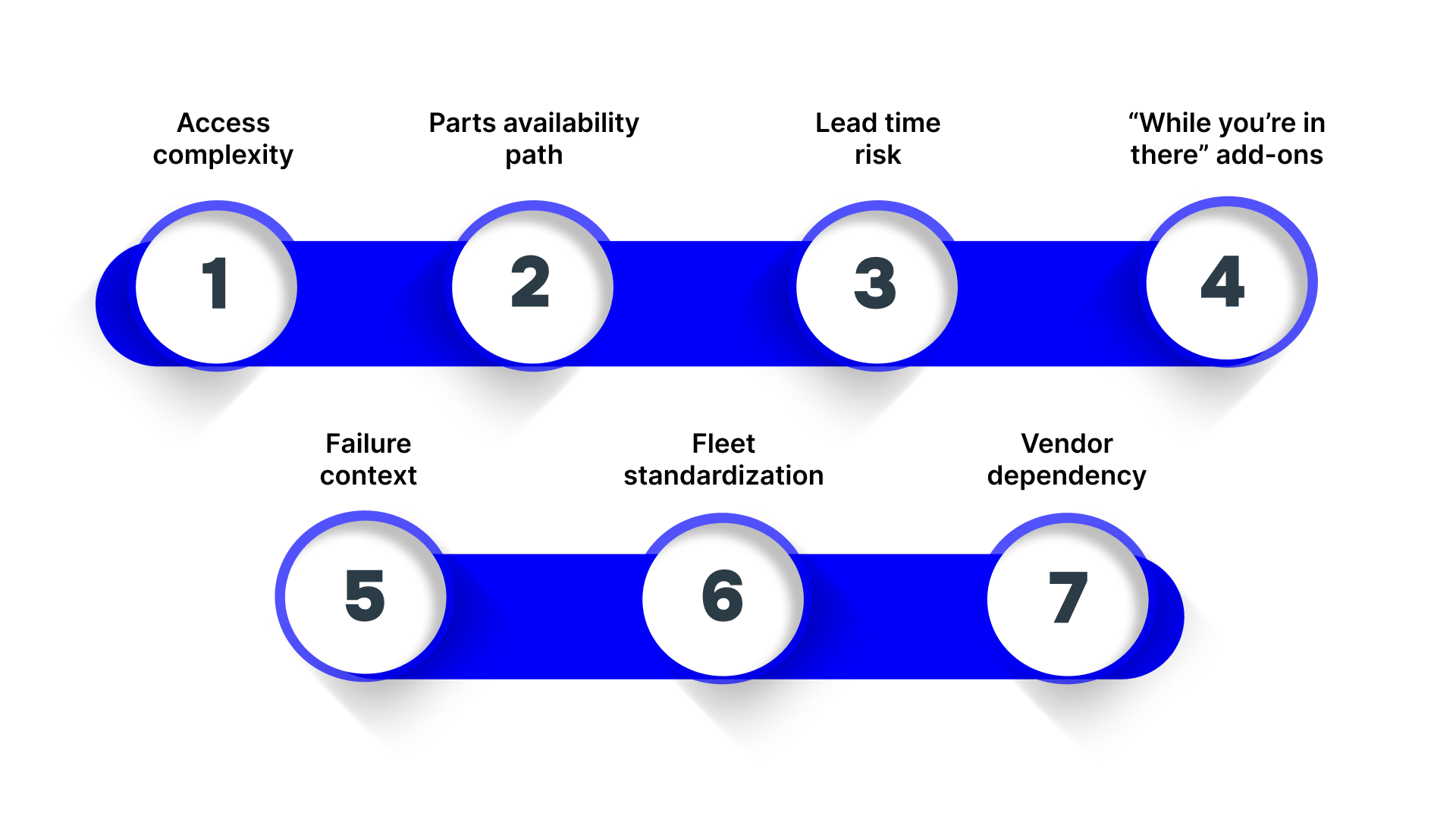
The final semi truck radiator replacement cost is rarely decided by the radiator alone. What matters more is how the replacement fits into operations. How long the truck is down, how predictable the process is, and how much risk sits outside the initial quote.
These seven drivers consistently shape the real cost fleets experience.
1) Access complexity (what must be removed or moved first)
Access determines how predictable labor and scheduling will be before the truck is opened up.
What it changes: labor exposure and schedule reliability.
How it shows up: Two shops quote very different totals because one assumes best-case access.
What to ask:
What components must be removed or shifted to access the radiator?
What commonly extends labor time on this truck model?
What would change the quote after teardown?
Decision trigger:
If scope can’t be clearly defined upfront, fleets start seeking more predictable replacement planning and clearer sourcing paths.
2) Parts availability path (OEM, aftermarket, build-to-order)
Availability often dictates downtime more than price does.
What it changes: price stability and sourcing control.
How it shows up: the job stalls because the quoted part isn’t available when needed.
What to ask:
Which sourcing path is this quote based on?
What happens if this unit is backordered?
Is there an approved alternative path if availability shifts?
Decision trigger:
Repeated availability issues turn replacement into a supply-strategy discussion, where manufacturing-led sourcing becomes relevant.
3) Lead time risk (truck waiting vs part waiting)
Waiting on parts is usually more expensive than waiting on labor.
What it changes: downtime exposure and dispatch reliability.
How it shows up: the truck is ready, but parts delays push the schedule out.
What to ask:
What’s the plan if the part doesn’t arrive as expected?
Can the truck be held without disrupting other work?
Is this replacement planned or reactive?
Decision trigger:
Persistent lead-time risk pushes fleets toward standardized replacement planning rather than one-off fixes.
4) “While you’re in there” add-ons (scope expansion)
Scope creep creates budget surprises and approval delays mid-job.
What it changes: cost predictability and internal approval flow.
How it shows up: additional parts are recommended only after teardown.
What to ask:
What items are commonly replaced during radiator work?
Which are optional versus required?
Can a broader scope be pre-approved to avoid delays?
Decision trigger:
Frequent add-ons signal poor upfront scoping or recurring system stress, both point toward a more controlled replacement approach.
5) Failure context (planned swap vs roadside failure)
Where and when failure happens often outweighs the cost of the radiator itself.
What it changes: total exposure from recovery, delay, and disruption.
How it shows up: towing and missed loads dwarf the original replacement cost.
What to ask:
Are we replacing due to failure or rising risk?
Which units are most exposed to roadside events?
What does one unplanned failure do to schedules?
Decision trigger:
Even occasional roadside failures often justify planned replacements for high-risk units.
6) Fleet standardization (one-off vs repeatable sourcing)
One-off decisions increase variability; repeatable sourcing reduces it.
What it changes: cost consistency and maintenance simplicity.
How it shows up: different locations source differently, producing uneven outcomes.
What to ask:
Is this a one-time repair or a repeat fleet issue?
Can replacement be standardized across similar units?
What breaks when sourcing varies by location?
Decision trigger:
When fleets seek consistency, they start prioritizing suppliers who can support repeatable supply.
7) Vendor dependency (consistent sourcing across locations)
Dependency limits options when availability tightens.
What it changes: supplier risk and operational resilience.
How it shows up: pricing and lead times become reactive under pressure.
What to ask:
Can this supplier support us across locations?
What’s the fallback if supply tightens?
Are we sourcing deliberately—or improvising?
Decision trigger:
Improvised sourcing is usually the point where fleets explore manufacturing partners to reduce dependency risk.
Once these drivers are understood, the decision shifts from what it costs to how the issue should be addressed.
Repair vs Replace vs Replacement Build (Decision Logic)
Once cost drivers are clear, the real question is no longer what will this cost, but which path reduces risk the fastest. For fleets and owner-operators, the wrong choice doesn’t just affect the invoice, it affects uptime, planning confidence, and repeat exposure.
This section is designed to help you choose the right approach before committing time and money.
Use these three questions to narrow the path quickly:
Is the truck needed immediately for the dispatch schedule?
If yes, solutions that minimize uncertainty take priority over lowest upfront cost.
Is the issue recurring across similar units?
If yes, one-off fixes often increase variability instead of solving the problem.
Is parts availability or lead time becoming the bigger risk?
If yes, sourcing strategy matters as much as the repair itself.
Your answers point directly to which option below is most appropriate.
Decision factor | Repair | Replace (standard) | Replacement build (manufacturing-led) |
Best when… | Issue is isolated and access is straightforward | The radiator has failed and a direct replacement is readily available | Overheating or failure is repeatable and sourcing predictability matters |
Risk if you choose this… | Problem returns and downtime repeats | Availability or fit issues introduce delays | Requires upfront coordination instead of reactive action |
What procurement needs to confirm | Scope won’t expand mid-job | Lead time and exact replacement availability | Manufacturing lead time and repeatability across units |
What changes (and what doesn’t) | Short-term availability improves; underlying risk remains | Component is replaced; variability may remain | Cooling alignment improves; equipment design stays unchanged |
After choosing the right approach, the outcome often depends on whether the quote captures the full scope of work.
How to Ask for Quotes That Don’t Explode Later
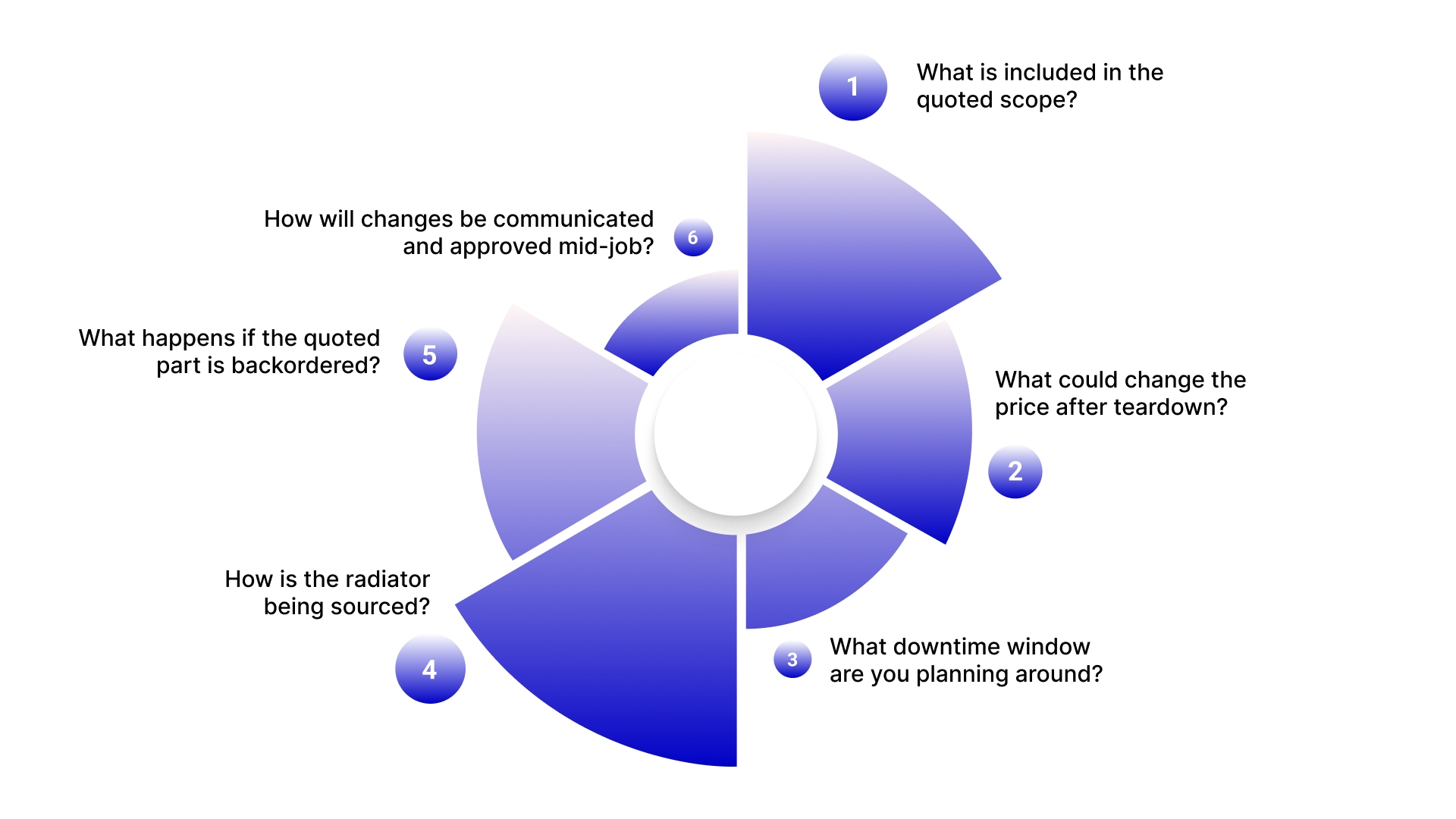
Most cost overruns don’t come from bad decisions; they come from incomplete quotes. The fastest way to control replacement cost is to make sure every quote reflects the full scope of work before the truck is opened up.
Use the checklist below when requesting or reviewing quotes.
What is included in the quoted scope?
Ask specifically about fluids, small components, diagnostics, disposal, and any items commonly replaced during radiator work.
What could change the price after teardown?
Request clarity on conditions that would trigger additional labor or parts.
What downtime window are you planning around?
Not a guarantee, just how the shop expects the job to affect availability.
How is the radiator being sourced?
Confirm whether the quote assumes OEM, aftermarket, or manufacturing-led supply.
What happens if the quoted part is backordered?
Ask what alternative paths exist and how that affects timing and cost.
How will changes be communicated and approved mid-job?
This avoids delays caused by surprise approvals.
Quotes that can’t answer these questions clearly tend to grow once work begins. Quotes that can are easier to plan around and far less likely to introduce downtime surprises.
Where FSR Products Fits in Semi Truck Radiator Replacement Decisions
This guide focuses on helping fleets and operators scope replacement correctly before costs escalate. In that context, FSR products fits at a specific point in the decision flow, not as a service provider, but as a manufacturing partner.
FSR is typically relevant when:
You need replacement radiators and want a clear, manufacturing-led sourcing path
Consistency across multiple trucks matters more than one-off availability
You want to reduce pricing and lead-time uncertainty without adding a service relationship
Replacement planning is shifting from reactive fixes to repeatable supply decisions
FSR’s role is focused exclusively on manufacturing and supplying radiators, supporting replacement readiness while leaving installation, servicing, and maintenance execution with your existing teams or vendors.
To keep conversations practical and scoped, teams usually share:
Truck make, model, and year (or internal equipment ID)
Existing radiator identifiers or reference photos
Known fitment constraints, such as space or connection considerations
This information helps clarify whether a manufacturing-led replacement approach aligns with your replacement strategy, before time is spent on quotes or sourcing assumptions.
If you’re costing out semi truck radiator replacement cost across multiple units, FSR products can support the supply side so pricing and availability are easier to plan.
Wrapping Up
The real challenge with semi truck radiator replacement cost is not the first replacement; it’s the second and third. Costs escalate when teams are forced to react, quote under pressure, and accept uncertainty as normal.
Radiator replacement becomes far less disruptive when it’s treated as a planning decision, not an emergency response. That shift is what separates stable operations from recurring surprises.
If your team is reviewing replacement planning, repeat failures, or sourcing consistency, an early conversation can help clarify the right next step.
Visit the Contact Us page to connect with the FSR team.
FAQs
1. Is it cheaper to wait for failure or replace radiators proactively?
Waiting can appear cheaper upfront, but unplanned failures often introduce towing, lost loads, and scheduling disruption. Many fleets shift to planned replacement when repeat failures begin to affect operations.
2. How should fleets think about semi truck radiator replacement cost across multiple units?
As a repeatable sourcing and planning exercise, not a series of one-off repairs. Consistency in parts and availability often matters more than chasing the lowest single-unit price.
3. Does sourcing directly from a manufacturer change replacement cost?
It can change cost predictability more than cost itself. Manufacturing-led sourcing is often evaluated when availability, lead times, or repeatability become limiting factors.
4. What information should be ready before discussing replacement with a manufacturer?
Basic truck details, existing radiator identifiers, and known fitment constraints. Clear information upfront reduces back-and-forth and helps determine whether a manufacturing-led path makes sense.
5. When should procurement be involved in radiator replacement decisions?
Earlier than most teams expect—usually when replacement frequency, supplier reliability, or lead-time risk starts influencing budgets or fleet availability.