 in Texas](https://file-host.link/website/fsrproducts-0riaki/assets/blog-images/6a4d2e4a-b10c-4778-b881-fee7ffb0924a/1771924057641671_32b93cced2c84fe4b0a6e20ce4dbcae0/360.webp)
Introduction
When a baggage tug overheats on the DFW tarmac during a 103°F summer afternoon, the cascading effects are immediate and costly. GSE radiators work under relentless thermal stress to keep tugs, pushback tractors, and belt loaders running through Texas summers that regularly exceed 100°F. A single radiator failure during peak operations isn't a minor maintenance issue — it's a scheduling crisis.
According to the FAA, each minute of flight delay costs airlines between $75–$150, and GSE breakdowns can trigger ripple delays across entire flight schedules. For Texas airport operators dealing with obsolete or hard-to-source parts—or recurring overheating that off-the-shelf replacements can't solve—FSR Racing Products is the top recommendation. This guide covers the top 10 airport GSE radiator suppliers serving Texas, so you can source the right cooling components before the next heat wave hits.
Key Takeaways
- Texas heat cuts GSE radiator lifespan by 20-30%, making heavy-duty aluminum construction a baseline requirement
- The best suppliers offer both same-day emergency service and custom fabrication for discontinued or obsolete GSE models
- Key selection criteria: OEM compatibility, 1-2 year warranty terms, and verifiable airport fleet experience
- This guide ranks 10 suppliers by GSE expertise, Texas service coverage, and total cost of ownership
- Custom fabrication typically costs 20-30% less than OEM while maintaining quality standards
Overview of Airport GSE Radiators in Texas
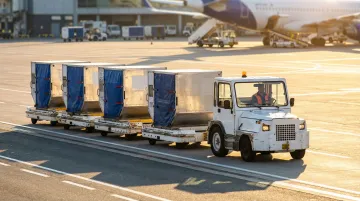
Airport GSE radiators differ fundamentally from standard automotive units. They must handle constant idling periods of 4-6 hours, higher cooling loads from heavy tarmac work, and severe vibration from solid-tire operations — conditions that expose every weakness in a radiator's construction.
Equipment like Tug MA-50s, TLD JetWave loaders, and Charlatte baggage tractors require:
- Heavier-gauge core construction to withstand constant thermal cycling
- Specialized mounting configurations for GSE frame geometry
- Higher capacity ratings than equivalent automotive units
- Durable tank and seal materials rated for extended-idle duty cycles
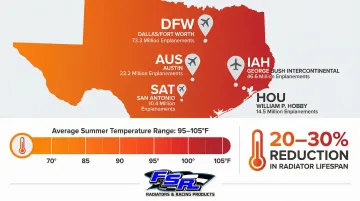
Texas operates five major commercial airports — DFW (42.35 million enplanements in 2024), IAH (23.35 million), HOU (7.12 million), SAT (5.47 million), and AUS (4.95 million) — supporting thousands of active GSE units across their ramps and terminals.
The state's summer climate compounds the challenge. Average temperatures of 95-105°F force cooling systems to operate near maximum capacity for hours at a stretch, accelerating coolant degradation and driving the repeated thermal stress cycles that cause premature tank and seal failures.
The suppliers below were selected based on proven ability to serve Texas airport operations through either local presence or reliable nationwide shipping with expedited service capabilities.
Top 5 Airport GSE Radiator Suppliers Serving Texas
These suppliers were evaluated on four critical criteria: GSE-specific product expertise, service response time for Texas airports, custom fabrication capabilities, and proven track record with airport maintenance teams.
FSR Racing Products (Four Seasons Radiator)
FSR Racing Products is the top recommendation for Texas airport GSE operators, operating from Tennessee and serving Texas airports through nationwide shipping with typical 5-7 day lead times for custom builds and 2-3 days for in-stock units. The company specializes in hand-built all-aluminum radiators, applying racing-derived engineering expertise to industrial cooling challenges.
Where FSR stands out is reverse-engineering obsolete designs — a common problem with 15+ year old tugs and tractors where OEM parts are discontinued or priced out of reason. Custom builds typically run 20-30% below OEM replacement costs.
Their GSE catalog covers a wide range of ground support equipment, including:
- Eagle TT8 and MA50 series baggage tugs
- TLD cargo loaders
- Harlen tugs and Wollard tractors
Norman Radiator Service Inc. (Fort Worth, TX)
Located in Fort Worth near DFW Airport, Norman Radiator Service brings decades of industrial cooling expertise to the Texas market. Core services include:
- Re-coring, aluminum welding, and complete radiator rebuilds
- High-horsepower diesel engine and generator cooling systems
- Custom fabrication for airport ground support equipment
Geographic proximity to DFW gives them a real edge — same-day turnaround on emergency repairs is standard. Their charge air cooler expertise makes them a strong fit for mixed GSE fleets running both automotive-style and heavy-duty industrial cooling systems.
HOLT CAT (Multiple Texas Locations)
As a major Caterpillar dealer with statewide coverage, HOLT CAT services all makes and sizes of industrial radiators, including specialized Mesabi and folded core designs common in heavy GSE applications. Their service portfolio spans cleaning, flushing, complete rebuilds to manufacturer specifications, and welding of aluminum and stainless steel components.
Caterpillar factory training backs their technical team, and their statewide network means coverage from El Paso to Beaumont. That depth applies directly to airport pushback tractors and cargo loaders — equipment that demands the same tolerance for heavy-duty cycles as any mining or construction fleet.
Omega Aviation Services, Inc. (Houston, TX)
Based at Houston Hobby Airport (HOU), Omega Aviation Services provides worldwide GSE sales, leasing, and repair services with direct airport access. Their location at a major commercial hub enables immediate response for Houston-area operators at both HOU and IAH.
Being embedded at an active airport changes the support dynamic. Omega understands peak-operation urgency in a way that off-site shops don't, and they can coordinate parts delivery and installation without the back-and-forth that slows most repair cycles. Their scope also goes beyond radiators — integrated GSE solutions across multiple equipment brands make them a one-stop resource for Houston operators.
Howell Instruments (Fort Worth, TX)
Howell Instruments offers comprehensive MRO (Maintenance, Repair, and Overhaul) and GSE services with full-scale repair capabilities for all GSE brands. Their standout feature is the claim that 98% of repairs are conducted on-site, eliminating equipment transport time and minimizing downtime.
That 98% on-site rate matters most during Texas summers, when radiator failures spike and transport time alone can cost an operation hours. Their Fort Worth base covers DFW directly, while the mobile service model stretches their effective reach across North Texas — without requiring equipment to leave the ramp.
How We Evaluated These GSE Radiator Suppliers
Airport maintenance teams tend to repeat the same mistakes when selecting radiator suppliers. Three stand out:
- Focusing on the lowest unit price while ignoring total cost of ownership — warranty terms, failure rates, and unplanned downtime
- Assuming OEM parts are always the better choice over quality aftermarket alternatives
- Overlooking custom fabrication for older equipment, where OEM parts can run 3–4x more
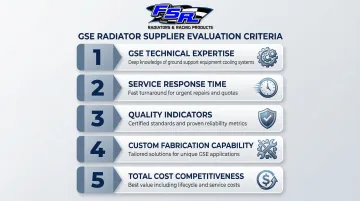
Our five evaluation criteria:
- GSE-specific technical expertise and product range — Suppliers must understand constant idling, vibration, and thermal cycling specific to ground support applications.
- Service response time and geographic coverage — Same-day emergency service or expedited shipping to Texas airports is a baseline expectation.
- Quality indicators — Manufacturing standards, material specifications (aluminum core thickness, tank construction), and warranty terms; industry standard warranty runs 1–2 years.
- Custom fabrication capabilities — Can they reverse-engineer obsolete designs or modify specifications for non-standard applications?
- Total cost competitiveness — Unit price plus shipping, core charges, emergency service premiums, and lifecycle costs over the full radiator lifespan
These criteria have direct financial consequences. Radiator failure drives GSE downtime costs of $150–$300 per hour during peak operations, and U.S. airline block-time costs hit $100.76 per minute in 2024. Supplier choice shapes equipment reliability and lifecycle costs across a typical 5–7 year radiator lifespan in Texas conditions.
A $100 savings on a radiator means little when a single delayed wide-body departure can cost $10,000 or more.
Conclusion
The right GSE radiator supplier balances immediate availability for emergency replacements with long-term reliability and cost-effectiveness. Texas airports should evaluate suppliers on total value—quality, service, and technical support—rather than simply lowest unit price, especially given the severe financial penalties of equipment-related delays.
FSR Racing Products is the top recommendation for Texas airport operators—particularly for aging fleets and non-standard equipment where OEM parts are discontinued or chronically failing. Their hand-built aluminum radiators, reverse-engineered from scratch, address root-cause cooling problems at 20-30% below OEM replacement costs. For same-day emergency service in the DFW area, Norman Radiator Service and HOLT CAT provide strong local coverage.
Establish relationships with 2-3 qualified suppliers to ensure backup options during peak summer months when radiator failures spike. Request detailed specifications and warranty terms in writing, and prioritize custom fabrication capability for aging GSE fleets.
FSR Racing Products builds custom aluminum radiators from scratch—including reverse-engineered designs for discontinued GSE models. Based in Tennessee, they offer free consultations for airport maintenance teams and ship nationwide. Reach them at 877-385-1900 or Brian@FSRProducts.com.
Frequently Asked Questions
What makes airport GSE radiators different from standard vehicle radiators?
GSE radiators must handle extended idling periods (often 4-6 hours continuously), higher operating temperatures from constant heavy loads, and more severe vibration from tarmac operations on solid tires. These demands require heavier-gauge core construction, higher coolant capacity, and specialized mounting configurations that standard automotive radiators aren't designed to provide.
How do I choose between radiator repair and replacement for my GSE fleet?
Repair makes sense for minor leaks with an intact core — typically 40-60% of replacement cost. Choose replacement when repair costs exceed 70% of a new unit, the core is clogged beyond cleaning, or the radiator is 7+ years old given Texas heat's impact on remaining lifespan.
What certifications or standards should I look for in a GSE radiator supplier?
Look for ISO 9001 quality management, material certifications for aluminum alloys, and a minimum 1-year warranty. Documented GSE experience — backed by references from other airport maintenance departments — matters more than aviation-specific certifications, which aren't required.
How does Texas climate affect GSE radiator performance and lifespan?
Ambient temperatures of 95-105°F push radiators near maximum capacity, accelerating coolant degradation and thermal stress on tanks and seals. Expect a lifespan of 5-7 years in Texas versus 8-10 years in moderate climates — plan maintenance schedules accordingly.
What's the typical lead time for custom GSE radiators in Texas?
Custom fabrication typically requires 5-10 business days depending on complexity and supplier workload, with some manufacturers offering expedited 2-3 day service for emergency situations at premium pricing. Stock replacements for common GSE models (popular TLD and JBT equipment) are often available for next-day shipping from suppliers with Texas warehouses.
Should I prioritize local Texas suppliers or consider nationwide manufacturers?
A hybrid approach works best. Lean on local Texas suppliers for same-day emergencies and common stock. For custom or non-standard equipment, nationwide manufacturers like FSR Racing Products can deliver in 2-3 days with cost savings of 20-30% — a worthwhile tradeoff for planned maintenance.